These 3 Kitchen Composters Are All on Sale, but Only One Makes Real Compost
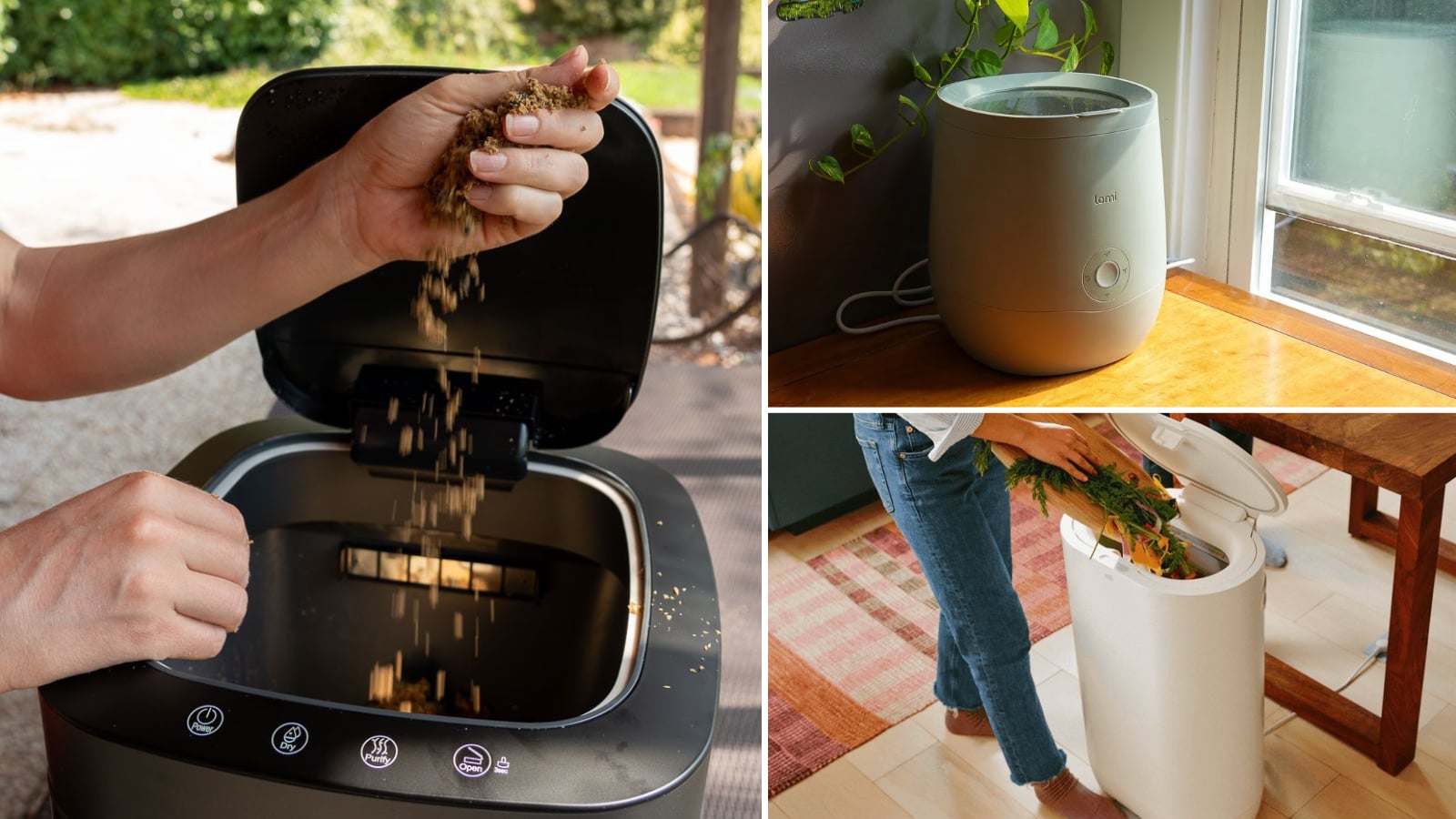
Reencle, Mill and Lomi are all kitchen composter machines with the same basic purpose: They get rid of the stinky, heavy, climate-polluting food scraps in your trash.
But the three machines work very differently, so the right one for your life depends on your schedule, your city, and your gardening ambitions.
The choice mostly comes down to one question: Do you want real compost for your garden or house plants, or do you just want less smelly trash?
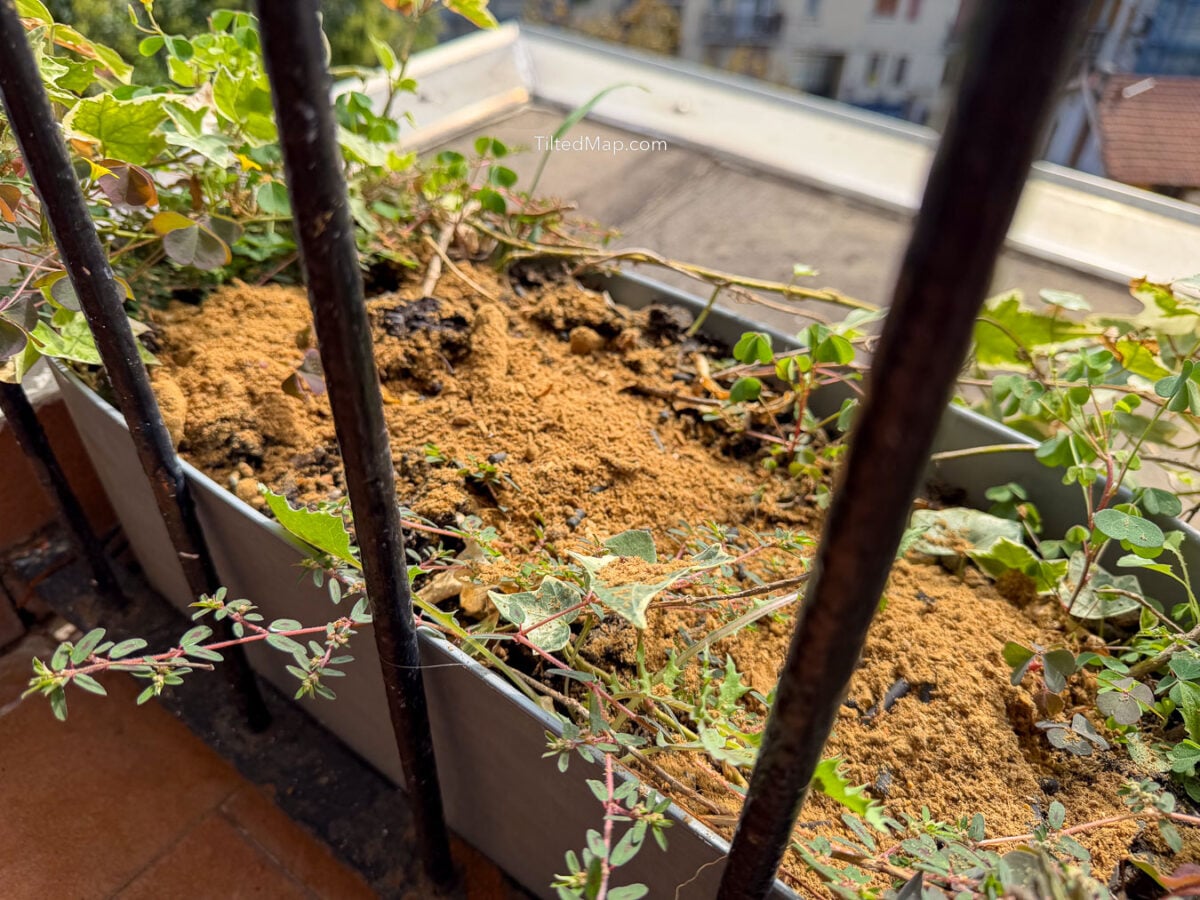
The short answer: Reencle is the only option of the three that actually makes living compost. Mill and Lomi dry and grind your scraps into a sort of “pre-compost,” which is less ideal if your goal is gardening.
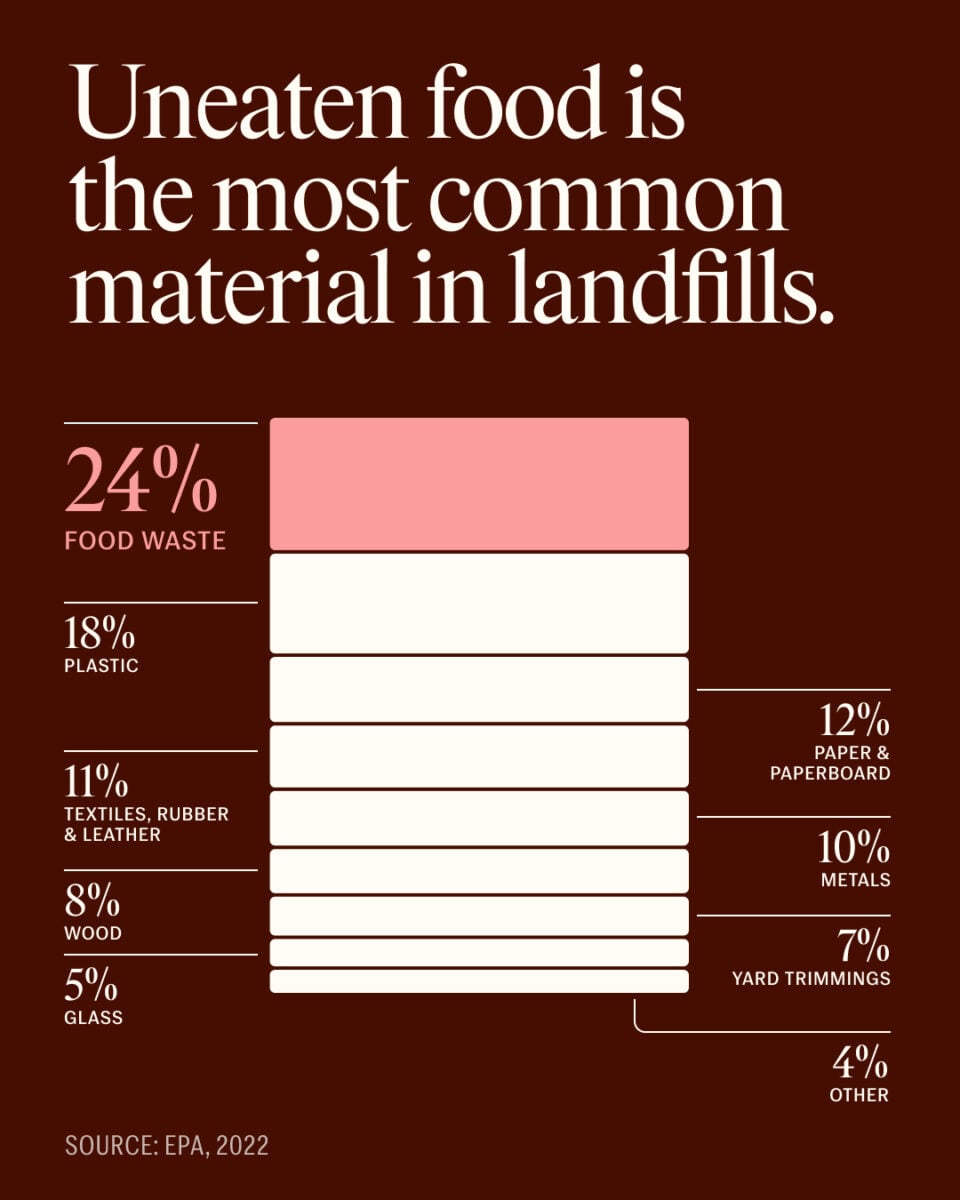
After many months testing the Reencle and the Lomi, I can confidently say these kitchen gadgets actually are an easy, realistic way to take control of our small roles in a really big problem. (The problem = food waste rotting in landfills creates methane, a greenhouse gas. And food is the single biggest category of waste we send to landfills in the US, at about 24%, according to the EPA.)
How I tested them (and what I didn’t)
I’ve tested all three versions of the Lomi, each for months at a time and some for years. (I bought the first one myself, and Lomi gifted me their 2nd and 3rd models.)
And I tested the Reencle Prime for about 3 months with my husband in Italy, sometimes for just the two of us and sometimes for a house full of guests. (Here’s my full Reencle review, which Reencle sponsored. As always, my opinions are my own and I shared both the good and bad.)
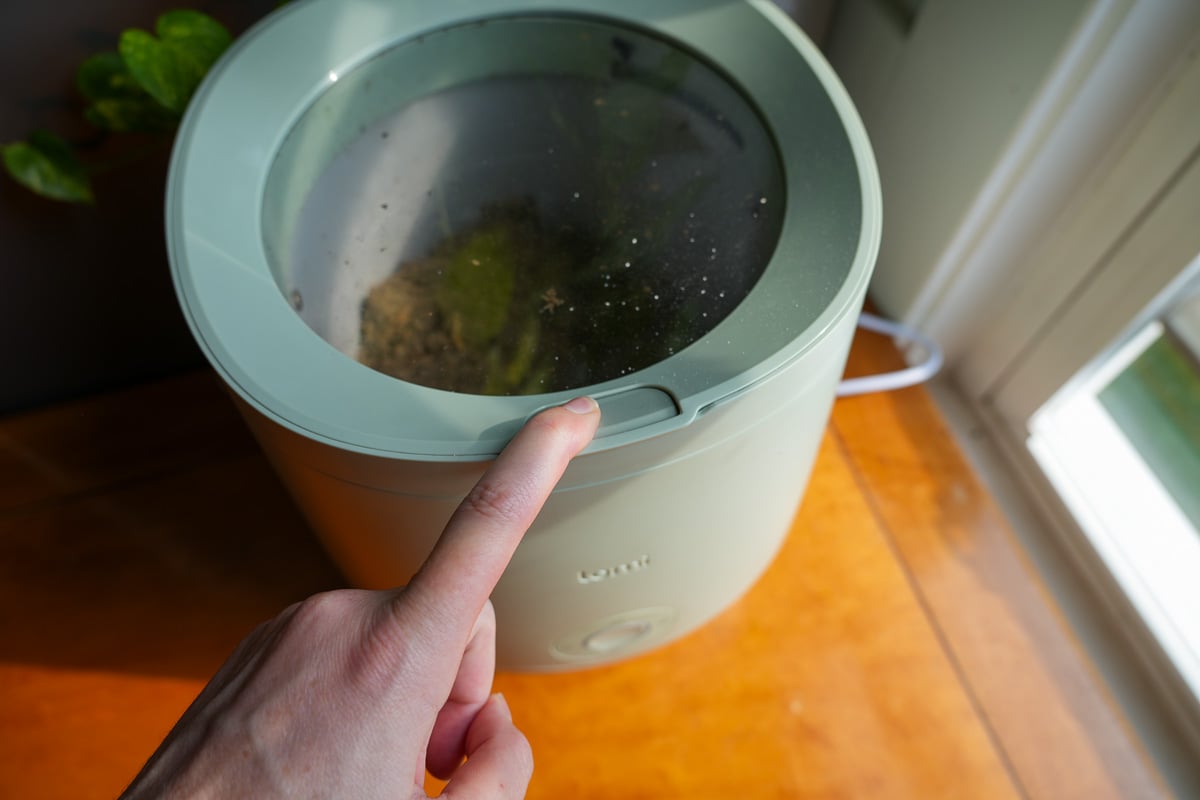
Reencle vs Mill vs Lomi at a glance (quick table)
This table is a mix of official stats and my actual experience using Reencle and Lomi. (I haven’t tested a Mill yet, so these are the company’s own specs.)
|
Mill (Essential / Plus) |
|||
|---|---|---|---|
|
How I know |
Mill’s own specs (haven’t personally tested) |
Personally used all 3 Lomi versions; specs from Lomi 3 |
|
|
How it works |
Microbes digest food continuously; you never turn it off |
Dries and grinds food once a day, on a schedule |
Dries and grinds in batches (you choose when) |
|
What comes out |
Compost; cure it (very easy) and mix 1:4 with soil before planting. (No curing for mulching.) |
“Food Grounds,” which Mill says aren’t compost yet |
“Lomi dirt,” a pre-compost I used to sprinkle on my yard |
|
List price (Nov 18, 2026) |
$549 |
$999 Essential; from $1,149 Plus |
$649 |
|
$150 off, Nov 19–Dec 31 ($399). |
$200 off, Nov 20–30 ($799 Essential; from $949 Plus). |
$150 off, Nov 13–Dec 18 ($499). Or $350 off with a membership ($299, + $120 / year) |
|
|
Where to shop |
|||
|
Ongoing costs |
Carbon filter every 9–12 months ($35) |
Filter: Essential $59 every 5–6 months; Plus $114 every 10–12 months. Optional Food Grounds pickup: $16 a month |
Filter refill $29.99 every 3 months or 45 cycles; OR the $120-a-year membership includes 4 refills |
|
Electricity |
About 1.25 kWh a day (8.75 kWh a week) |
About 0.7 kWh a day, Mill Plus median (about 4.9 kWh a week). Essential: Unknown |
1 kWh per Express cycle, 1.1 kWh per Grow cycle (about 2 kWh a week at 2 cycles) |
|
Capacity |
Max 2.2 lb (1 kg) a day; 1.5 lb (0.7 kg) recommended. Best for 1–3 people. (Gravity model for larger households) |
6.5 L (1.7 gal) bin. No daily limit listed; Mill says most households empty it every 4–6 weeks |
3 L (0.8 gal) per cycle. With two people, we ran 2-3 cycles a week. |
|
Size and weight |
12 × 13 × 18.4 in (31 × 33 × 47 cm); 20.1 lb (9.1 kg) |
Essential: 17 × 14 × 23 in (43 × 36 × 58 cm), 45 lb (20.4 kg). Plus: 27 in (69 cm) tall, 56 lb (25.4 kg) |
11 × 11 × 12 in (28 × 28 × 30 cm); 16 lb (7.25 kg) |
|
Bones and pits |
Small, soft bones only; no large bones or pits |
Yes, including turkey bones and avocado pits |
No hard bones or pits (fish bones are OK) |
|
Noise |
About 28 dB |
About 42 dB |
Under 45 dB |
|
Travel options |
Wind it down and restart for trips over a month (process takes a couple days) |
Automatic vacation mode, but still plugged in while you’re away. |
Empty it and unplug |
|
Where it ships |
US (AK and HI cost $100). Contact for international shipping & use discount code TILTEDMAP |
Continental US only |
US, Canada, EU and UK |
|
Trial / warranty |
60 days / 2 years |
90 days / 2 years |
90 days / 1 year (3 years with membership) |
Reencle, Mill or Lomi: which should you buy?
Reencle wins if you actually want to use compost on your plants, or if you just want the lowest price for a quality machine.
Mill definitely wins if you need to toss in bones and pits, and you don’t care about using the compost yourself, since you can mail the grounds away. (But I don’t love the idea of adding yet another package that has to be shipped, and the emissions and energy use that come with it.)
Lomi wins if you travel a lot (since you can just unplug it between batches) and you mainly want less smelly trash, but using the compost on plants isn’t so important to you. It’s also the smallest of the three machines, and it uses the least electricity.
None of them win if your city, or a local company, already picks up food scraps, and you don’t need the compost yourself. The most sustainable option is often no new gadget at all.
And if you do have room, time and desire to deal with an outdoor pile, that’s obviously a great solution that doesn’t require buying a new appliance. But I assume you’re here because you don’t. That’s okay!
Compost vs dried scraps: What the machines actually make
As it turns out, not all home compost machines produce… compost. But that may or may not matter to you.
Reencle: the most compost-like
The Reencle is the only one of the three “composters” that produces something very close to real compost. That’s because it’s the only one that uses microbes, which digest food scraps, like how they would naturally break down in a compost pile.
Think of it like a sourdough starter: you keep feeding it, and what it produces is alive, too.
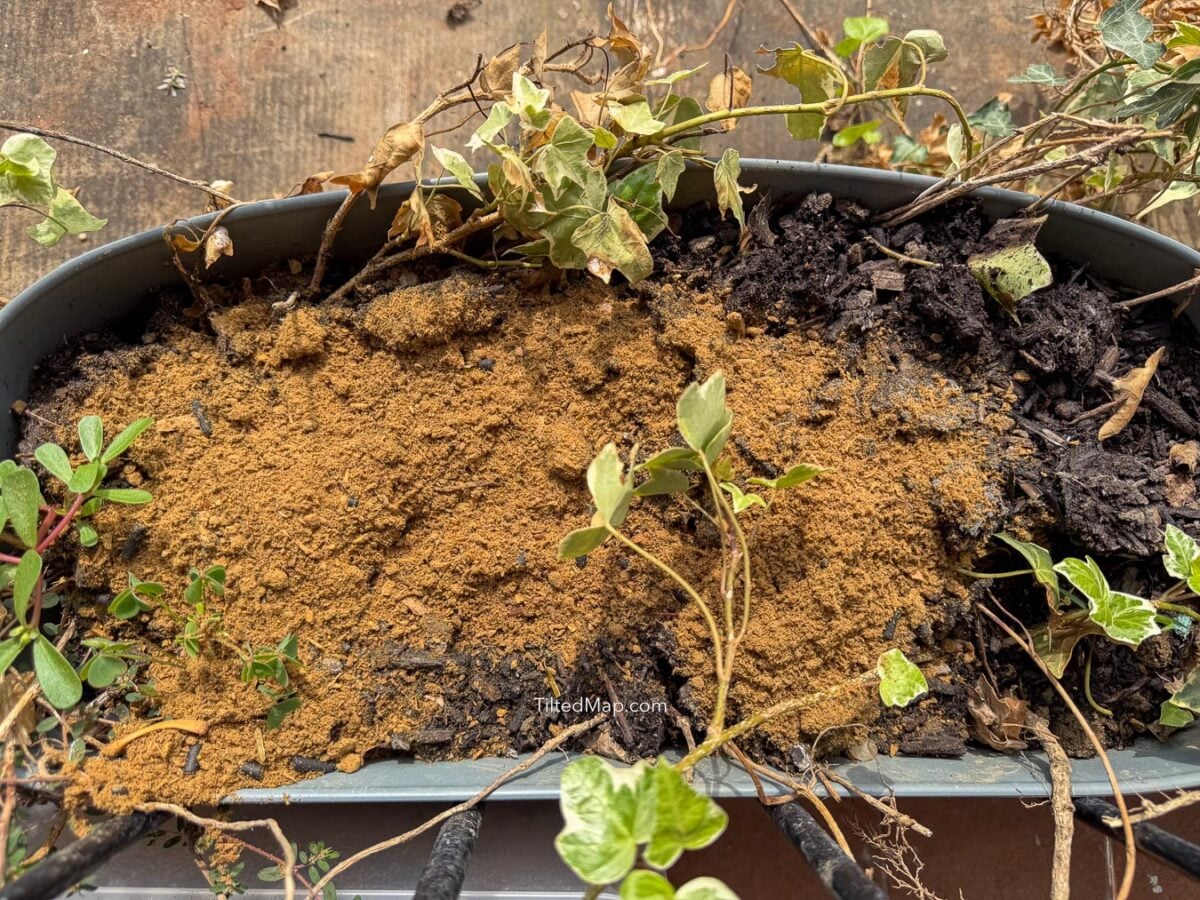
The compost isn’t quite finished when you scoop the dirt out of your Reencle, though, since you keep adding fresh scraps every day. So you need to cure it for a few weeks before it touches roots or seeds. Don’t worry, curing is very simple. For mulching, you can use what you take out of the Reencle right away.
(We spread ours on our potted plants after only about 2 weeks, breaking several of Reencle’s curing rules along the way. The plants were fine.)
Mill: not compost, and not easy to make it compost
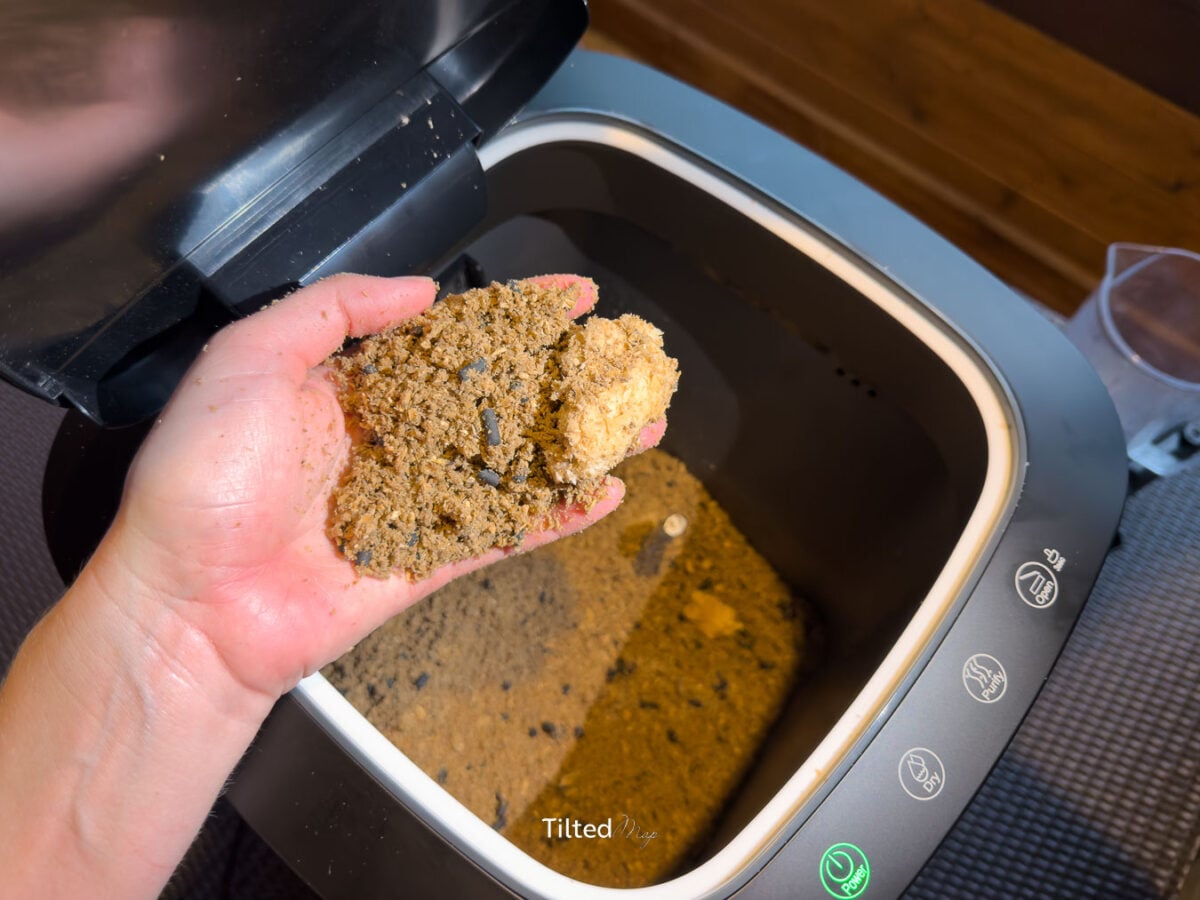
Instead of microbes, Mill dries and grinds food on a schedule into what it calls Food Grounds, which it says “aren’t compost (yet).” It’s very similar to Lomi.
You can technically use Food Grounds at home, but Mill itself calls it “a delicate process,” which doesn’t seem like a good sign. You have to mix the grounds with a lot of soil. (Or, they suggest feeding them to chickens or putting them on a regular outdoor compost pile. That might be useful if you have a pile you can’t use year-round, such as anywhere with freezing winters.)
If you do mix the Food Grounds with soil, even as Mill recommends, they can still cause mold and odors, and attract pests.
And if you don’t have a yard, a compost pile, chickens, or a city compost program? The main option is Mill’s pickup service, at $16 a month.
Lomi: almost compost
The Lomi works a lot like the Mill: no microbes, just heat, grinding and drying, but in batches that you run whenever you want.
The result is a “pre-compost” that Lomi calls “Lomi Earth” (aka Lomi dirt). For gardening, you’re supposed to mix it with 10 parts soil, and I can promise you that advice actually matters. (I’ve had moldy house plants when I spread Lomi dirt on them without mixing. More on that in my Lomi review.)
If you want to use Lomi Earth on plants, that’s what the machine’s longer Grow cycle is for. (And you should add a LomiPod and a little water.) It takes up to 17 hours per cycle, but with lower heat, so the energy use is almost the same.

Cost to own: first year and beyond
Here’s what each machine costs to actually use for a two-person household. (I calculated these using the list price for each composter, plus any additional inputs you have to buy, and electricity at the average 2026 US rate of 18.2 cents per kWh.)
In the first year:
- about $667 for the Reencle Prime ($549, plus $83 of electricity and a $35 filter)
- about $788 for the Lomi 3 ($649, plus $19 of electricity and (officially) $120 for a year of filters, although we replace them less often)
- about $1,164 to $1,310 for Mill ($999 for the Essential or $1,149 for the Plus, about $120 of filters, and $47 of electricity. Not counting Food Grounds pickup.)
Every year after that:
- about $118 for the Reencle
- $139 for the Lomi
- $161–165 for the Mill. And Mill’s optional Food Grounds pickup adds another $192 a year.
Reencle’s new Essential model costs $100 less than the Prime ($449 list) and uses a little less electricity (0.95 kWh a day). You can put the same amount of food in it every day, but Reencle says it suits 1–2 people instead of 1–3. (Here’s my Reencle model comparison.)
How much electricity does each one use?
Reencle says the Prime uses about 1.25 kWh a day (drawing 52 W at any given moment, on average, for you engineers). That’s about $83 a year at the average 2026 US electricity price, or $6.92 a month.
Lomi says the Lomi 3 uses 1 kWh per Express cycle (which takes 3–6 hours) and 1.1 kWh per Grow cycle (11–17 hours, the cycle you use if you want to use the output on plants). At two Express cycles a week, that’s about 8.7 kWh a month, or roughly $1.60 a month.
For a two-person household, the Lomi uses less electricity. At two cycles a week, what we usually did when staying home and cooking often, the Lomi 3 uses roughly 2 kWh a week, versus about 8.75 kWh a week for the Reencle Prime.
After learning this, I’m thinking of buying a plug-in meter to measure exactly what both machines consume, since I do own both of them.
Compost machines vs compost pickup service
Private compost pickup costs $20 to $50 a month in most US cities and towns, which is about $240 to $600 a year. So a machine can pay for itself, eventually.
Compared against the low end of that range, the Reencle pays for itself in about 4½ years, and the Lomi in about 6½.
Against the high end, both pay for themselves in about a year and a half or less.
The Mill takes the longest: more than 10 years against cheap pickup, or about 2½ against expensive pickup.
(Those are all considering list price and counting ongoing costs.)
So it really depends how much compost pickup costs in your city. Some cities pick up food scraps for free, or as part of your trash bill, like New York City, Boston and Seattle. If your city offers that, it’s usually the cheapest and most sustainable option.
Noise, smell and setup: living with each one
Where the Reencle beats Lomi, in my opinion: It makes real compost, it’s quieter, and you never have to think about whether to run a batch or wait for more scraps. (If your family is stressed out by this with the dishwasher, it’s definitely a factor to consider!)
Smell:
We’ve never been able to smell our Reencle while it’s running, just a yogurt-y smell when we open the lid.
The Lomi has a bit of a yeasty smell while it runs, in my experience, especially when the filters aren’t super new. I haven’t used a Mill, so I can’t tell you how it smells.
Noise:
In the beginning, I often opened the Reencle to double-check it was actually on, because I couldn’t hear it at all. The Lomi 3 is MUCH quieter than earlier Lomis. It’s actually meaningfully better. You’ll still hear it while a cycle runs, but barely.
Starting up:
The Mill and the Lomi work as soon as you plug them in.
The Reencle takes about a week to get going, because you’re waking up a colony of microbes. (You add the starter mix and water, and give it a limited “diet” for the next few days. It’s not complicated, but if your Reencle arrives the day before Thanksgiving, don’t plan on using it for the feast!)
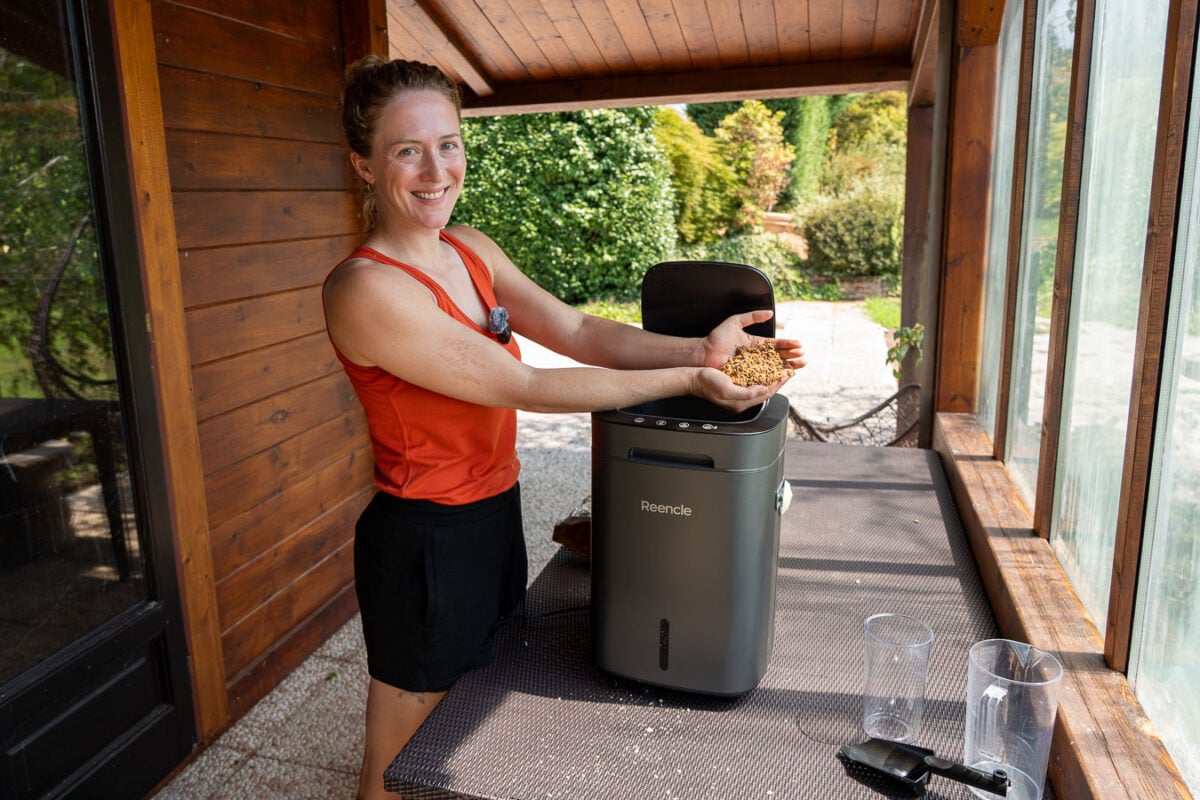
Conflicting startup instructions:
Reencle’s website says to wait 3–6 hours before the first feeding; the manual that came with ours said 18–24 hours. (And our paper quick-start guide was mysteriously delivered in Czech.)
How often it runs:
The Reencle runs all the time, so you add food scraps whenever you have them.
The Mill runs on its own once a day, on a schedule, and you empty the bin every few weeks.
With the Lomi, you fill the bucket and then decide when to run a cycle. For the two of us, that’s a cycle every few days.
Size, lids and where each one fits
The Reencle Prime model weighs about 20 pounds (9.1 kg) and is fairly compact (think the size of a stand mixer or espresso machine).
At 18.4 inches tall (47 cm), it might not fit under most cabinets, if you want it on the kitchen counter, where we kept ours. (Apparently the standard gap is 18 inches.) And the lid definitely won’t open all the way under most upper cabinets (it needs about 29 inches, or 73 cm, of height to open fully).
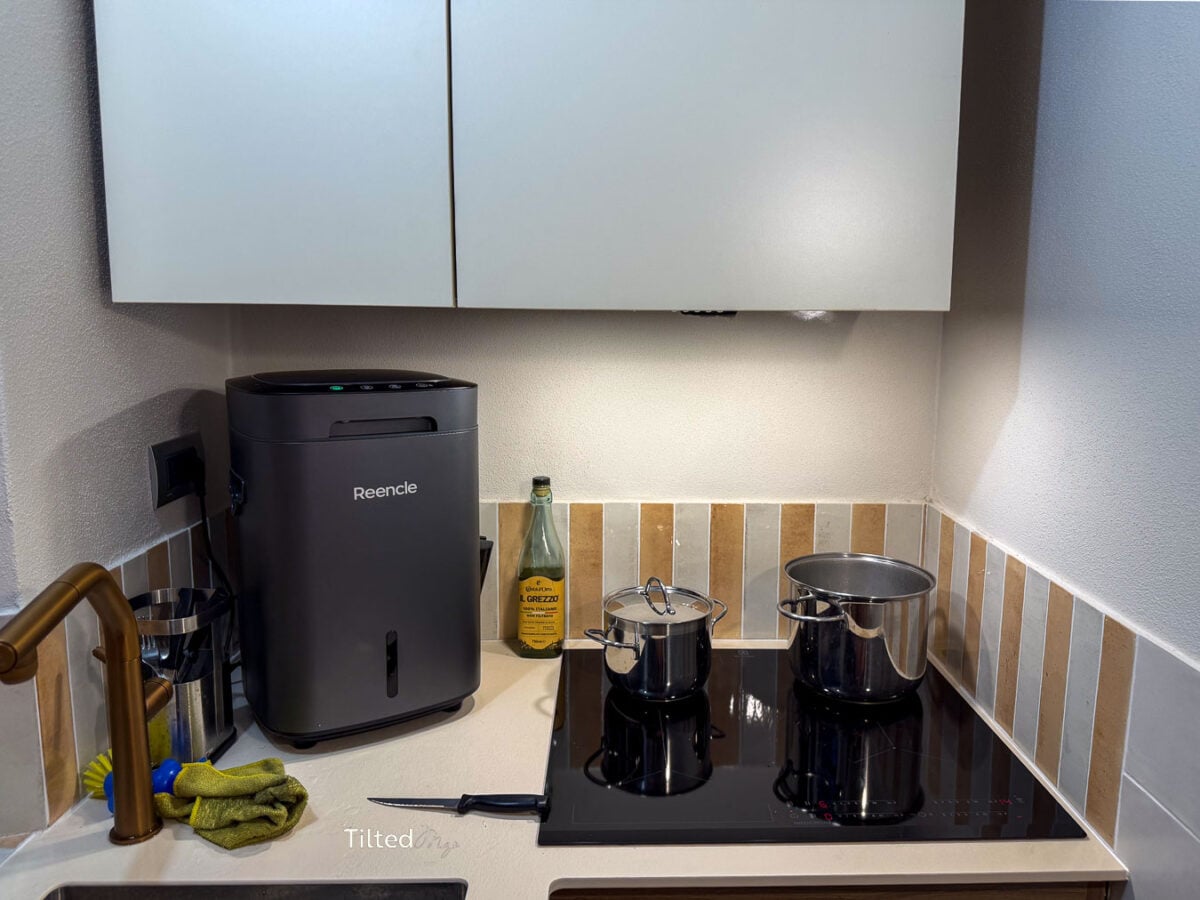
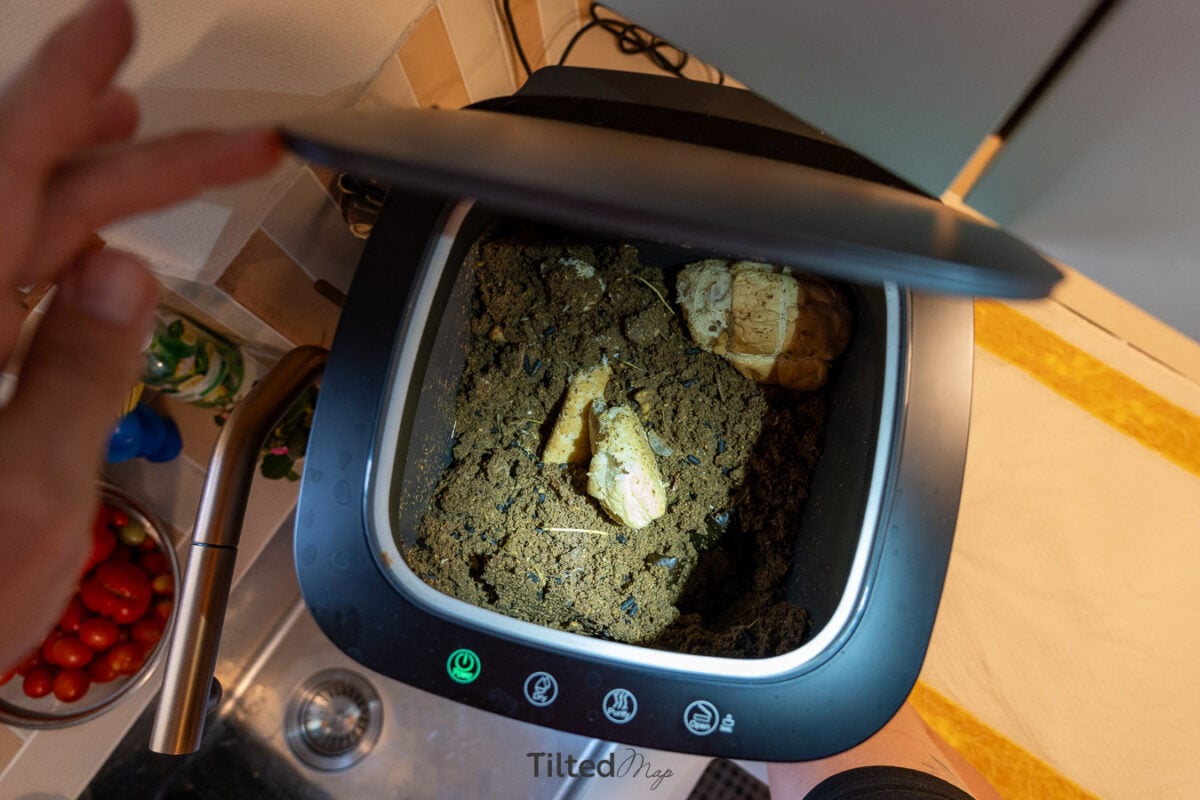
The design has a hands-free lid with a motion-activated sensor, which we found convenient, but you can also turn it off if your kids or pets might activate it. (Hold the open button for 3 seconds to turn it off. Another 3 seconds locks the lid completely.)
The Lomi 3 is the smallest of the three, at about 12 inches tall and 16 lb, so it fits under any upper cabinet.
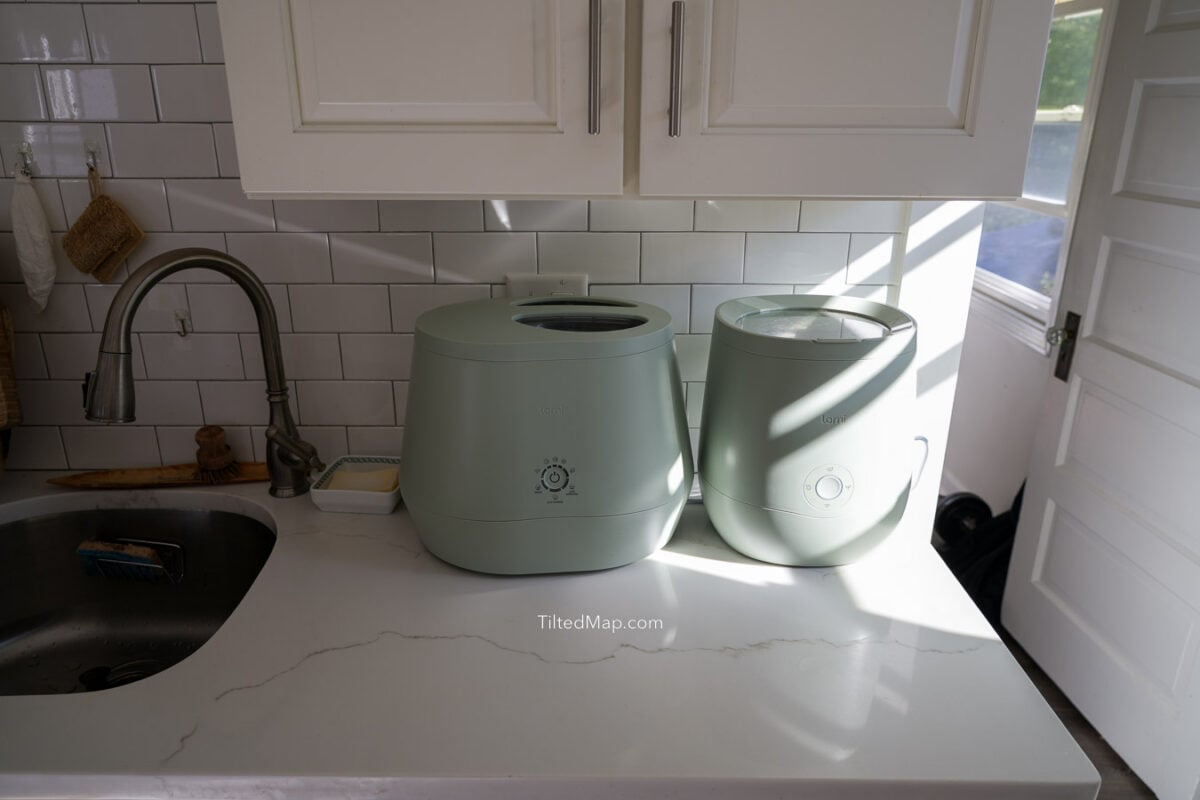
The Mill is in a different category. It’s 23 inches tall (Essential) or 27 inches (Plus) and weighs 45 to 56 lb, so it sits on the floor, like a kitchen trash can, not on the counter. That saves counter space, but you’ll need a spot on the floor near an outlet. The Essential’s lid stays up when you lift it, and the Plus opens with a foot pedal.
Best composter for travelers
As a sustainable travel writer, this is the part I think about most, since we’re often on the road for weeks or even months at a time.
The Lomi is the easiest to leave. Empty it, unplug it, and go, whether you’re away for a weekend or a whole season.
The Mill has an automatic vacation mode, so they say you can leave it alone while you’re gone.
The Reencle takes the most planning. For trips under a month, you leave it running and add some extra food or water before you go. But even a few days away dried out our microbes a bit. They weren’t dead or anything, so no big deal. But now we add water before we leave and a bit more when we get back. For a month or longer, you have to taper off feeding it over about a week, unplug it, then restart it slowly when you’re home. And if the microbes die, you have to buy new ones.
What I’d do
If I were buying one of these for myself today, it would be the Reencle. I want compost for our plants, and I don’t want to think about when to run a batch. Plus, I have renewable energy at my apartment, so the extra power isn’t as much of a concern.
But if I didn’t care about the compost, and mainly wanted less trash when I’m home, and a simple set-up for traveling as much as I do, I’d stick with our quiet and cute Lomi 3.
Whichever one you choose, buy it directly from the brand, so you get the full trial period and support the small businesses that are actually designing these innovative machines.
Trial periods and what happens if you send it back
The trial is 60 days for Reencle, or 90 days for Mill and Lomi. That way you can test it in your own kitchen, with your own food scraps, and still send it back if it’s not for you.
And since I hate knowing how many returned items end up in a landfill, I asked all three brands what happens to them. They all told me returned units get refurbished to make sure they’re in good condition, then reused.
Reencle says customers return 3–5% of its machines, and it sends them to people on its “Try at Home” monthly subscription plan. Lomi says 6% are returned, and it resells or donates them. Mill didn’t share the number of returns, but says it reuses the latest-generation machines and sends others to an electronics recycler.
What do you think?
Have you tried any of these? Leave a comment below with your thoughts or questions. (Remember, I’m a real person, and I read every comment!)