
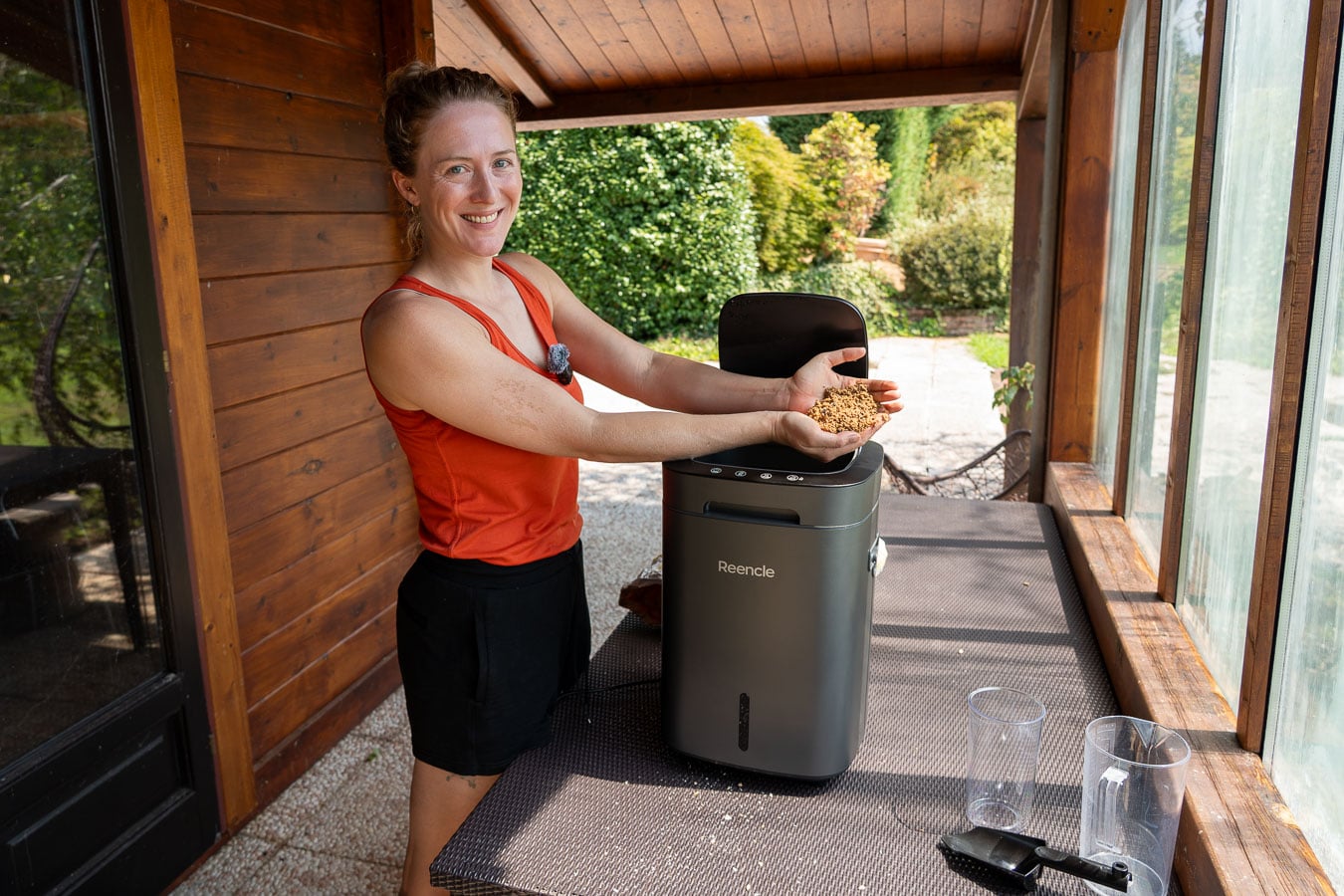
I’ve Tested Kitchen Composters for 4 Years. This Korean One Actually Makes Real Compost
You might already think of Korea as being ahead of the West in some things, like boy bands and 10-step skincare routines, but there’s another we can add to the list: Composting.
South Koreans recycle about 95% of their food waste, up from 2% in 1995. So since they’ve proven change really is possible, it makes sense that one of the best compost machines I’ve tested comes from there.
The company is called Reencle (pronounced like “wrinkle”), and I tested the Reencle “Prime” for about 3 months. It’s a surprisingly silent, odorless machine that runs continuously in your kitchen, feeding on your food scraps like a Tamagotchi pet.
I’ve tested a lot of food scrap compost machines, and Reencle is definitely different.
It actually produces real compost, using microbes that break down food waste, instead of just slicing, dicing, and dehydrating waste, the way other machines do.
My quick verdict: if you want real compost for a garden or potted plants, but don’t want an outdoor compost pile, I now think this is the best of the indoor composter solutions. One exception: If you’re often traveling for a month or more, it might not be for you. And overall, a local compost service is still often the most sustainable option, if you have one available.
If you do decide to try a machine, here’s my discount code to use when you buy directly from Reencle. (Which also supports real reviews like this one, written by real human beings!)
 Reencle Home Composter
The cleanest, quietest, easiest way I've found to make REAL compost in your house.
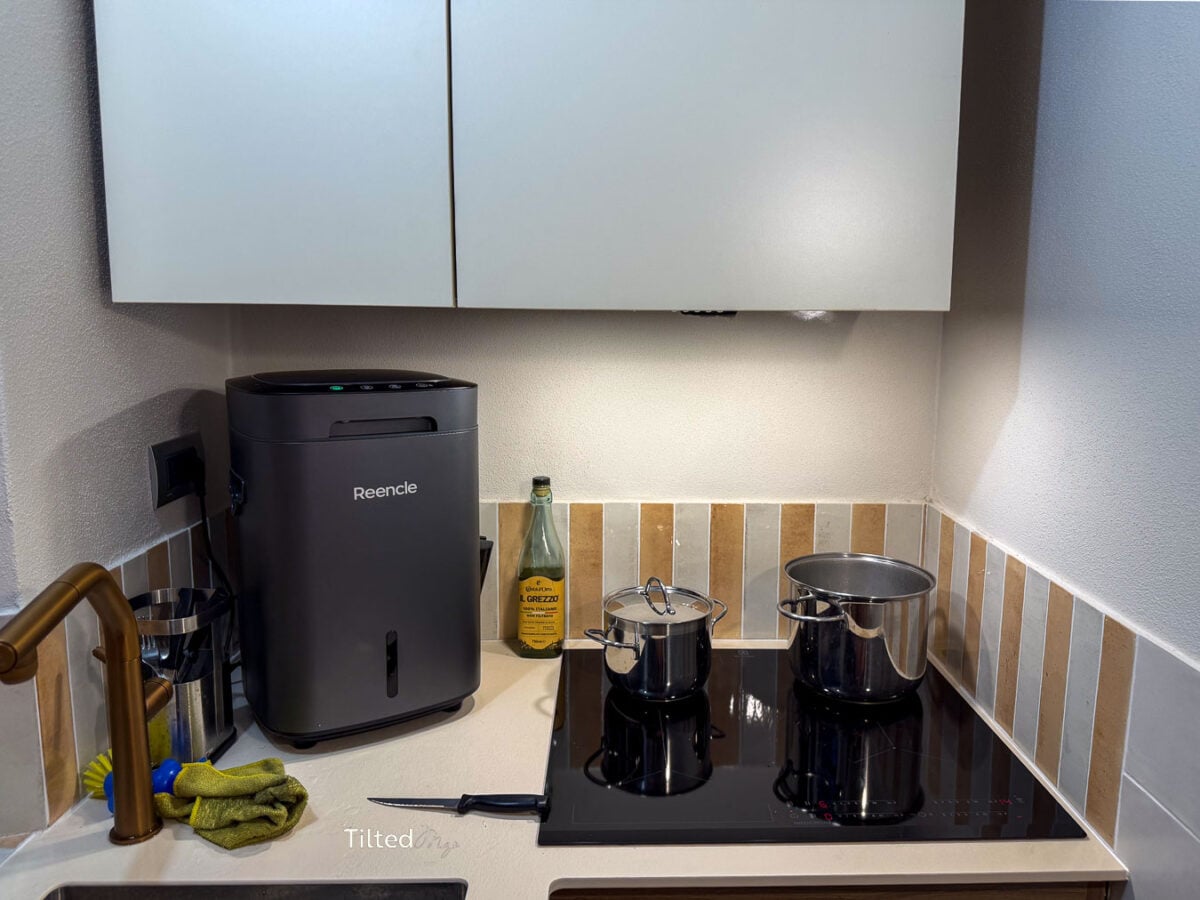
Reencle Prime: Facts at a glance
- What we tested: the Reencle Prime, gifted by Reencle for this review
- How: My husband and I used it for about 3 months while visiting family in Italy, sometimes just for the two of us, sometimes for lots of guests.
- Price: $549 list price (but save with our discount code!)
- Size: Like a tall mixer. About 12 × 13 × 18.4 inches (31 × 33 × 47 cm). The lid needs about 29 inches (73 cm) of height to open fully. Weighs 20.1 lb (9.1 kg).
- Capacity: 1.5 lb (0.7 kg) of scraps a day recommended, 2.2 lb (1 kg) is the max. This model is designed for 1 to 3 people
- Electricity: about 1.25 kWh a day (Reencle’s figure). Similar to running a ceiling fan or charging a laptop for 25 hours.
- Noise: about 28 dB (according to Reencle), which is a soft whisper. We could very rarely hear it, even while in the same room!
- Recurring costs: a new carbon filter every 9 to 12 months ($35)
- Trial period: you can test once at home for 60 days and still get your money back if you decide it’s not for you. (Only if you purchase directly from Reencle or from Amazon. I recommend direct, because Bezos doesn’t need any more of our money, and I’d rather support the people who invented this product, without giving a billionaire a cut.)
- Warranty: 2-year warranty
- Best for: if you want compost for plants or your yard, without an outdoor pile. Skip it if you’re often traveling for a month or more.
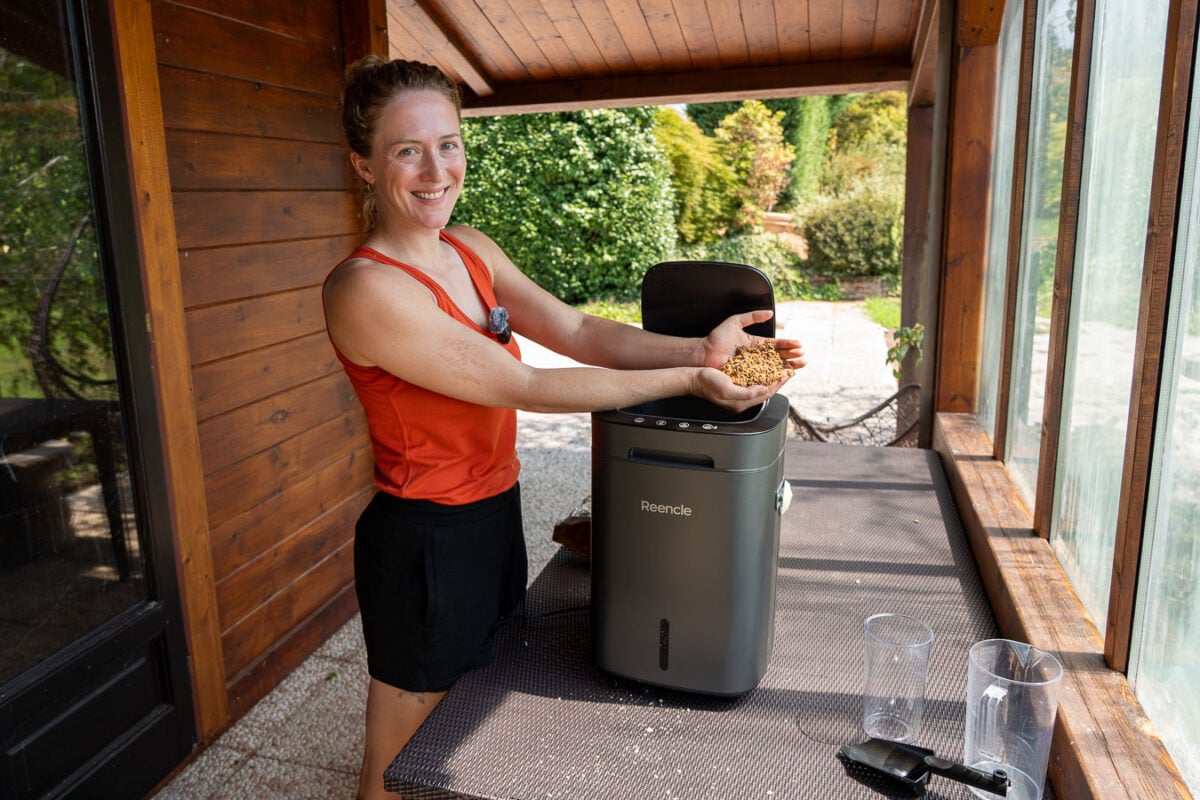
Who’s writing this review? (A real person)
Hi, I’m Ketti Wilhelm! I have a master’s degree in sustainability, and I started Tilted Map in 2019 to share realistic ways to live (and travel) more sustainably, without shaming and blaming us for the world we live in.
I write detailed reviews of products that claim to help you waste less, and I only review things I’ve actually used at home or on my travels. And I’ve been composting in my small apartment for years.
And I want to say thank you to Reencle for sponsoring this review and sending me the Reencle Prime we tested. As with every review I write, my opinions are my own, and no sponsor or affiliate partner ever gets control over what I write. (You’ll find the things I don’t love about Reencle in this review, too.)
If you decide to purchase a Reencle, using my links and discount code supports my work at Tilted Map, so I can keep testing useful products like this! (Especially in the age of AI overviews, when it’s increasingly difficult to get humans like you to see my work.) Thank you for being here!
Why I keep testing electric composters
I’ve been testing indoor electric compost machines for almost 4 years now (wow, time flies). I’ve put the dirt from my machines in potted plants and sprinkled it around my back yard (when the landlady downstairs wasn’t home).
The reason I keep toying with these machines is simple: They’re an easy, realistic way for normal people to take control of their small slice of a really big problem, which none of us created, but we all have the power to change.
That, in a word, is pretty much my jam.
What I wish everyone knew about composting, though, is that it’s not just a good idea if you want to start your trad-wife life, or become a back-to-the-land farmer.
The biggest problem with food waste going into a landfill is methane. When food waste breaks down in an anaerobic situation, like a landfill, it doesn’t just waste a resource that could be used to grow other crops. It creates methane, an extremely powerful greenhouse gas.
Yes, the first solution to food waste should, of course, be better meal planning to waste less food. (The food wasted in the United States and Europe would be enough to solve all world hunger, if we could just distribute it better, according to a book on the topic.)
Yes, we are talking about using electricity to avoid climate impact, which is obviously an issue. But it depends on the source of your energy. (Which you can control by opting for 100% renewable electricity, something you can do in some form in every state! We switched to a 100% renewable provider when we lived in Boston and it even cost slightly less.)
Now, back to what I’ve learned testing our Reencle.
What is Reencle, how does it work, is it real compost?
Similar to other compost machines I’ve tested, the Reencle uses gentle heat and mixing to help break down foods. What makes it very different from other composters is the addition of natural microbes that help break down waste in a way that’s much more similar to traditional compost, or really, nature.
Think of it like a sourdough starter: it’s something you have to continuously feed, and keep alive, and what it produces is alive, too. You still have to mix the output with regular soil, but less than other composters.
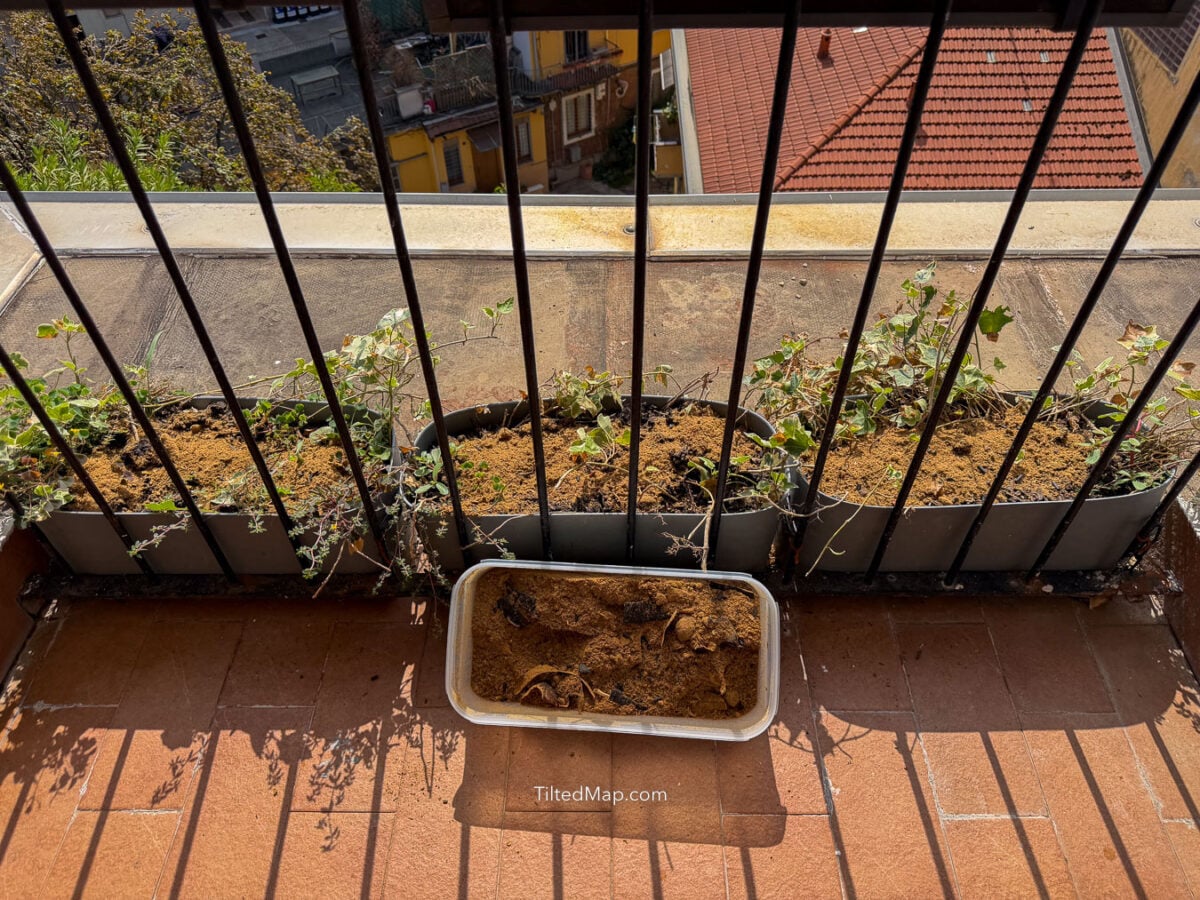
What goes in Reencle and when?
The short answer: almost anything you can actually eat can go in Reencle. And then some.
Tip: These rules apply only once it’s up and running. The first week has a special startup diet, which I’ll get to below.
You can add unbleached paper towels, tissues or paper, which actually help balance out wet food. (As long as they’re mixed in with food, not all in a bunch. Reencle suggests cutting them into “finger-sized” pieces, but we’ve just been ripping them into a few chunks with no problem.)
Yes to meat, fish, dairy, leftovers and even small, soft bones. (Although there were mixed messages on bones. The product page says no bones of any size; the help center says small, soft bones are fine. We didn’t have any problems with small chicken bones.)
Avoid large bones and pits (looking at you, avocado, mango, peach), and shellfish shells. They even say not to add onion or garlic skins, but that is another rule we’ve definitely been breaking, again without any issues. They seem to break down just fine in our Reencle.
Coffee grounds are fine in small amounts (about 40–50 grams a day, or a half cup). But they don’t actually break down, so they’ll build up over time.
Bonus: Adding some coffee grounds can help control odors, if your Reencle ever gets stinky. (Ours hasn’t, but who knows, maybe the grounds from our daily Italian moka have helped with that.)
Anything plastic is officially a no, including “compostable” coffee pods. (However, when I asked the Reencle team directly on a call, they told me products labeled for home or even industrial composting are okay, but they take longer to break down, about 45 to 60 days, so add them sparingly.)
Tip: Compostable bioplastics are designed to be industrially composted, not thrown in a standard compost pile or most home machines. (And only in Reencle if you’re patient.) Industrial composting uses advanced systems, like higher heat and more stable conditions, to break down tougher stuff faster.

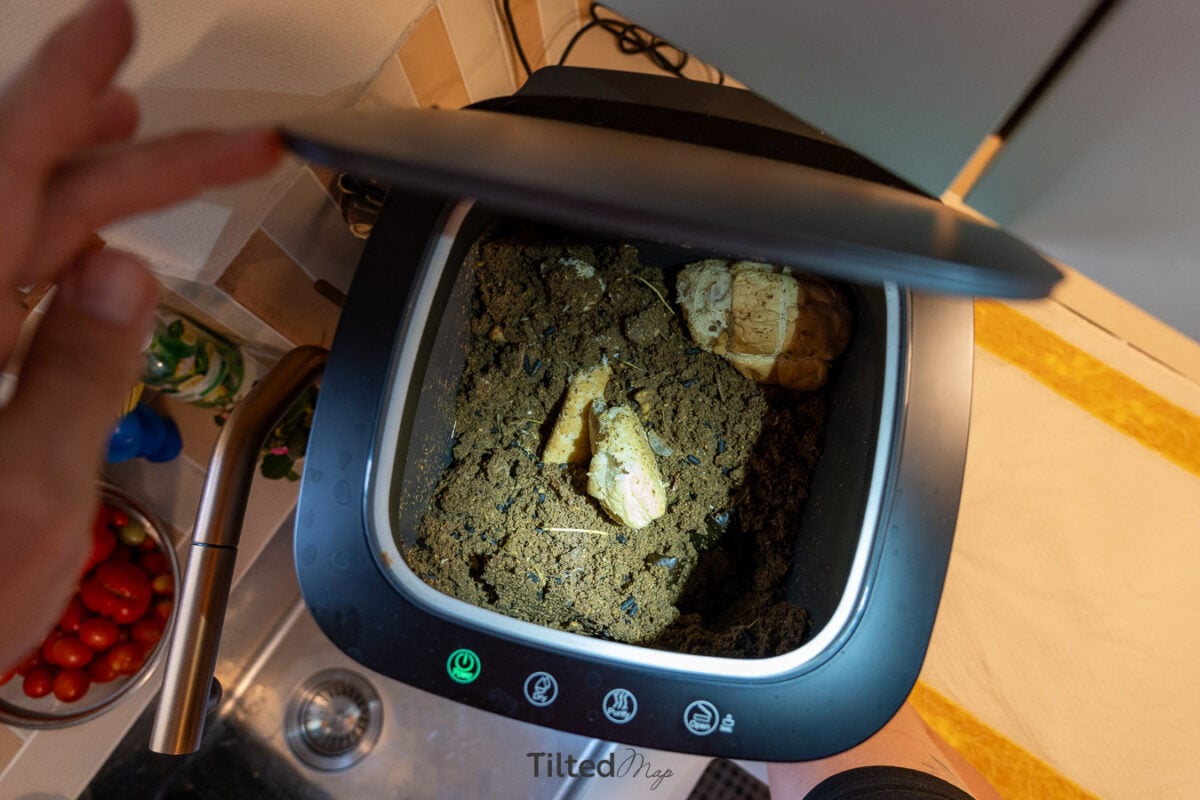
1. A day’s food for Reencle, plus our test coffee pod 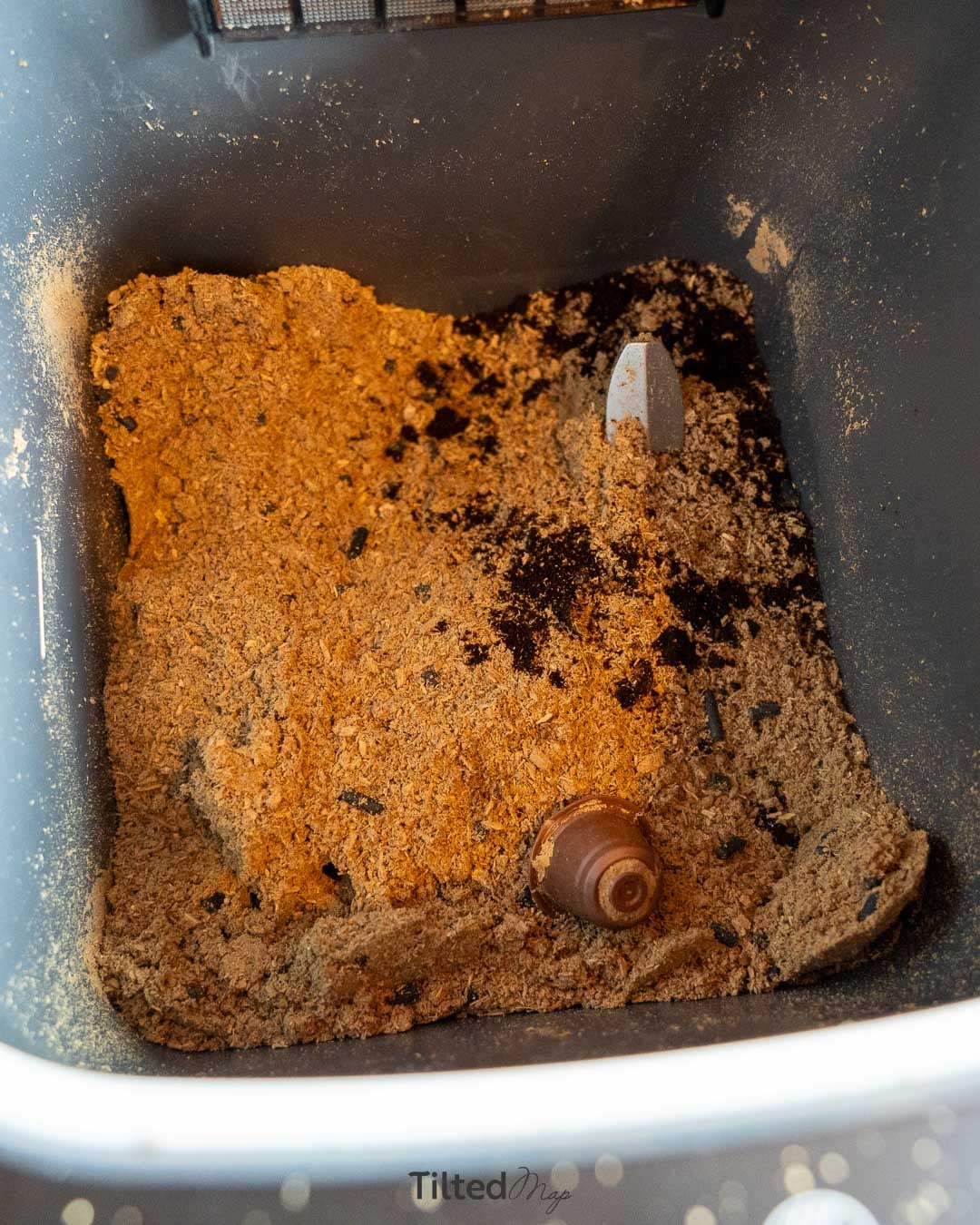
2. The “compostable” coffee pod looking exactly the same the next day 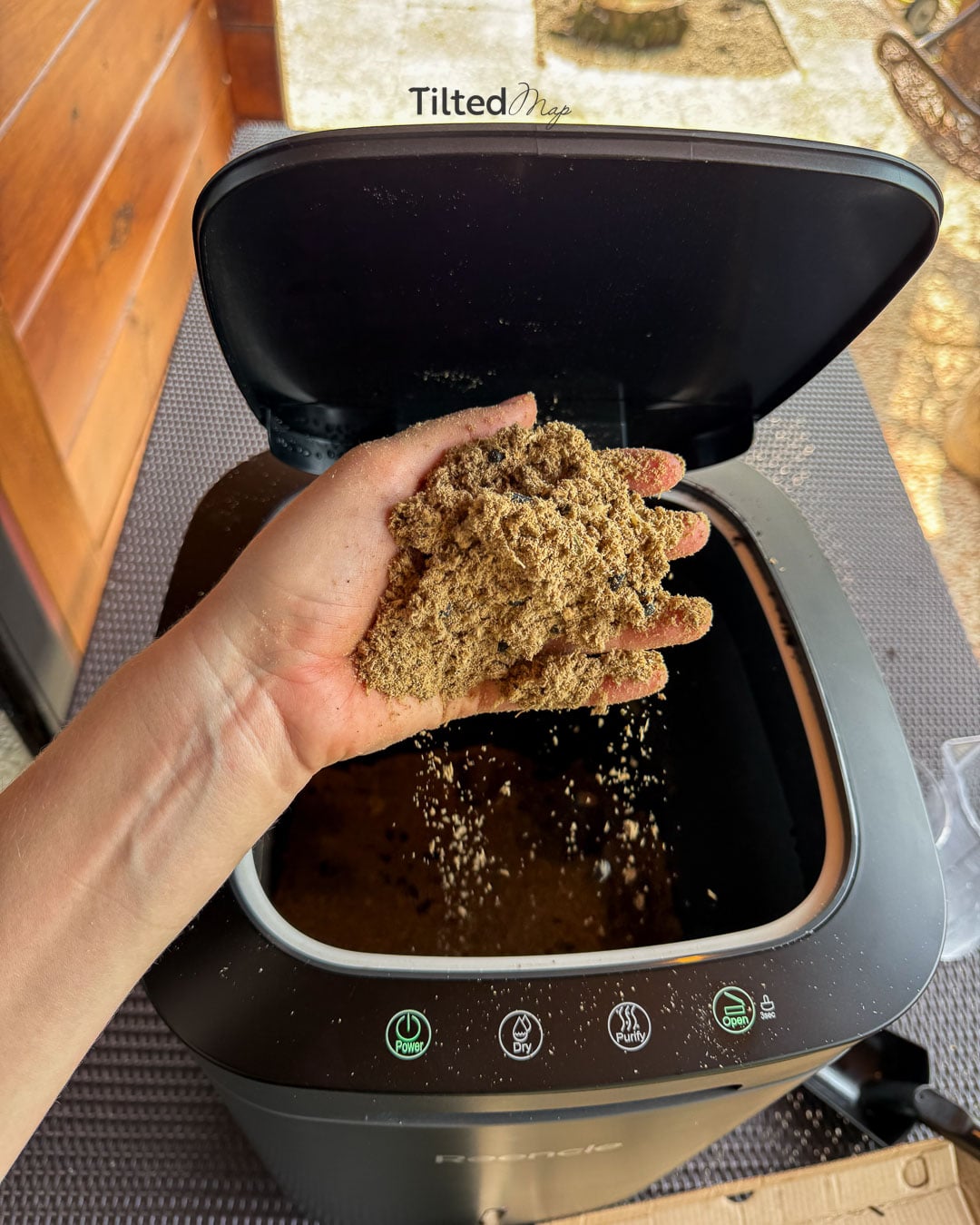
3. But everything else from the batch was perfectly broken down!
Korea’s food waste revolution
South Korea has had a national law requiring recycling food waste, both commercial and domestic, since 2005. They’ve also charged people based on how much their garbage weighs since 1995, which certainly encourages keeping heavy food waste out of dumpsters.
That’s actually how Reencle got its start, launching in Korea in 2019, after six years of R&D, as a solution to make it easier for people to follow the food waste law. Instead of having to haul it to a collection point, Reencle made it possible to just compost it at home, even in small apartments in Seoul.
Since food waste breaks down in landfills to create methane, the rest of the world would do well to follow their lead. While I won’t hold my breath waiting for a federal law here in the US (California did pass one in 2016), you can get ahead of the national curve and start composting, even without a backyard.
And Reencle is bringing composting to a much bigger scale in the US with the MegaReencle, a machine that composts up to about 220 pounds of food waste a day. Organizations from the Air Force to a Detroit food co-op, to universities and high schools have installed them, so maybe it would be a good idea to bring to your boss or PTA? It’s such an exciting way to create change on a massive scale! (And they’re the kind of composters that can handle compostable bio-plastics, like coffee pods and drink cups.)
Reencle’s claims vs our results [table]
Here’s Reencle’s official info, and our quick numbers on what we noticed ourselves.
| What | Reencle’s figure | Our result |
| How we tested | – | About 3 months, usually for 2 people, sometimes lots of guests. |
| Noise | About 28 dB | Rarely heard it, even in the same room. (When we did, it was easily fixed with water.) |
| Food scraps per day | 1.5 lb (0.7 kg) recommended, 2.2 lb (1 kg) max | We stopped measuring after the first week, but amounts varied a lot. It handled it all just fine. |
| Smell | Odor-free, with a 3-layer filter | No smell at all while running. A fermented sort of smell when it’s open |
| Time to break down food | Most scraps within about 24 hours; bread in 6–8 hours | Bread was almost entirely gone after ~6 hours. Harder foods take longer, but you don’t have to pay much attention to it. |
| Time until harvest | 2–4 weeks to fill at about 2 lb (1 kg) a day | It took 2 weeks until it was full. |
| Ongoing costs | Carbon filter every 9–12 months ($35) | Haven’t had to buy one yet. No smell after 3 months. |
What we LIKED about Reencle
Details on both the pros and cons from our experience are below, but here are our main take-aways.
- Quiet and odorless. In the beginning, I often opened it to double check it was actually on because I couldn’t hear it at all. We’ve never been able to smell it while running, just a yogurt-y smell when we open it.
- Real compost, not dried food scraps. The microbes digest the food instead of just drying and grinding it, so what comes out is much closer to traditional compost.
- No batches to plan. It runs all the time, so you never have to decide whether you’ve got enough scraps to run it.
- Fast once it’s going. Our first 250 grams of bread almost entirely disappeared after 6 hours.
- Hands-free lid option. The motion sensor opens the lid, and you can easily turn it off if kids or pets set it off.
- It takes almost all food. Meat, dairy, leftovers, peels and small soft bones can all go in.
- An actually useful trial period. You get 60 days from delivery to return it.
What we DIDN’T like about Reencle
- It ships with some Styrofoam. One bummer I discovered while unboxing my Reencle, that hopefully they’ll be able to change.
- It uses more electricity than other compost machines. (Details below and full comparison coming soon.)
- No instant gratification. The initial setup period takes about a week. It’s not complicated at all, but if the machine arrives the day before Thanksgiving, don’t expect to use it for a crowd the day of the feast.
- Long trips take a little planning. If you’re away for more than a month, you have to shut down the Reencle, not just unplug it.
- It’s not cheap. Here’s what it costs to own: the Prime is $549, plus about $83 a year worth of electricity (details on electricity use below). Plus you’ll need a $35 carbon filter every 9–12 months. That’s around $670 in the first year (about $620 with my discount code), and about $120–130 a year after that. The Essential costs $100 less up front and about $20 less every year in electricity.
Reencle Home Composter
The cleanest, quietest, easiest way I've found to make REAL compost in your house.
Other possible Reencle problems:
Reencle’s troubleshooting pages for the Prime give you an idea of potential issues: Bad smells, noises, a blinking “dry” or “purify” light, leaks, or a stuck mixing rod. According to Reencle, smells usually come down to moisture imbalances, which then trigger the error lights. (Either too much wet food or not enough bread or paper towel in the mix.)
We’ve already dealt with two of these, and both were very minor.
On our first morning after feeding Reencle, the “dry” mode was mysteriously turned on, even though nobody had pressed it. A little research told me it isn’t supposed to start automatically. It was either some kind of garden goblin, or a faulty control board, which would have been a free fix under Reencle’s warranty.
A month later, the “purify” button came on, stayed on for two days, then went away and everything kept working.
There was also a grinding noise a couple of times when the compost got too dry (because of travel neglect), but adding water fixed it.
Don’t buy a Reencle if this is you:
If you know you want an indoor compost machine, I wouldn’t recommend Reencle only if you frequently travel on long trips (more than a month). And I mean, very frequently, the way I do as a sustainable travel writer.
Nothing to worry about if you’re taking short trips. Officially, for anything under a month, you just leave it running and add some extra food or water before you go.
But if you’ll be gone for a month or longer, it’s a bit more of a process to wind down and then reawaken your microbe colony. (You’ll need to plan ahead several days before leaving, then unplug it.)
But when we were gone for even a few days, the compost was dry and noisy when we got back. (Reencle says a grinding, dry-friction sound is a sign of dry microbes.) Now we know to add water before we leave, and a bit more when we get back, but I imagine the microbes might not even last a month, with how dry they were after just a few days. And if they die, you have to buy new ones, which would add up.
Reencle Prime vs Essential vs Gravity: Which should you buy?
Reencle now sells three different models. The Prime, which we tested, is the middle-of-the-road version, though I’m not sure it’s the best. I haven’t tested the Gravity or the new Essential, so these are Reencle’s specs.
| Essential | Prime (tested) | Gravity / Gravity Pro | |
| Household size | 1–2 people | 1–3 people | 3–4+ people |
| Food per day (recommended to max) | 1.5 to 2.2 lb (0.7 to 1 kg) | 1.5 to 2.2 lb (0.7 to 1 kg) | 2.2 to 3.3 lb (1 to 1.5 kg) |
| Size (W × D × H) | 12 × 13.3 × 17.2 in (30 × 34 × 44 cm) | 13 × 12 × 18.4 in (33 × 31 × 47 cm) | 12.4 × 13.7 × 20.6 in (32 × 35 × 52 cm) |
| Weight | 19.6 lb (8.9 kg) | 20.1 lb (9.1 kg) | 24.9 lb (11.3 kg) |
| Electricity | 0.95 kWh a day | 1.25 kWh a day | 1.13 kWh a day |
| Noise | 27 dB | 28 dB | 24 dB |
| Price (Nov 2, 2026; list / sale) | $449 / $349 | $549 / $449 | Gravity $649 / $549; Pro $699 / $599 |
| Extras | – | – | Pro adds a Wi-Fi app and built-in scale |
In short: the Prime is good for most 1–3 person homes.
But the Essential is their new budget model (launched in September 2026), and honestly it seems like a good option to me. It has the same daily capacity as the Prime, but it’s a little smaller and lighter, and uses less power. (They say it’s for 1–2 people instead of 1–3.) It doesn’t have the automatic lid opening sensor (just an open button). Everything else is the same and it costs $100 less.
The Gravity model takes 50% more food a day than the Prime, and even though it’s bigger, it’s a little quieter and uses a little less power (Reencle says its motor is more efficient).
Reencle Alternatives:
If this isn’t quite what you’re looking for, here’s where I’d look instead:
Lomi:
I’ve used all three versions of the Lomi. The biggest difference is that Lomi runs in batches, not constantly, so it uses less electricity than the Reencle. (About 2 kWh a week for two people, versus about 8.75 kWh for the Reencle.) You can unplug it between uses, so it suits frequent travelers better.
>> Here’s my full Lomi review
But the Reencle makes real compost (Lomi doesn’t have microbes), it’s quieter, it doesn’t smell, and you never have to plan a batch.
Mill:
Mill dries and grinds food into what it calls Food Grounds, which it says “aren’t compost (yet).” (Similar to Lomi.) It’s bigger than the Reencle and roughly twice the price, but you can throw bones and avocado pits into it.
Reencle still wins if you want compost for your plants, a smaller machine or a lower price.
>> Full comparison of all three options coming soon!
Our experience with Reencle: Unboxing
Getting my Reencle out of the box and set up was pretty easy, with just two glitches: First, Styrofoam packaging.
It’s always a bummer to see a sustainability-focused company shipping with plastic packaging materials, and Styrofoam is the worst kind of plastic.
Some of Reencle’s packaging was already cardboard, so I’m hoping they upgrade more of it to cardboard inserts, like the kind I’ve seen sustainable wineries ship bottles in.
Note: Reencle told me they’ve tested multiple plastic-free alternatives, which all caused the heavy units to be damaged during shipping. They said they’re actively looking for an alternative to nix the Styrofoam, so I’m looking forward to what they come up with.
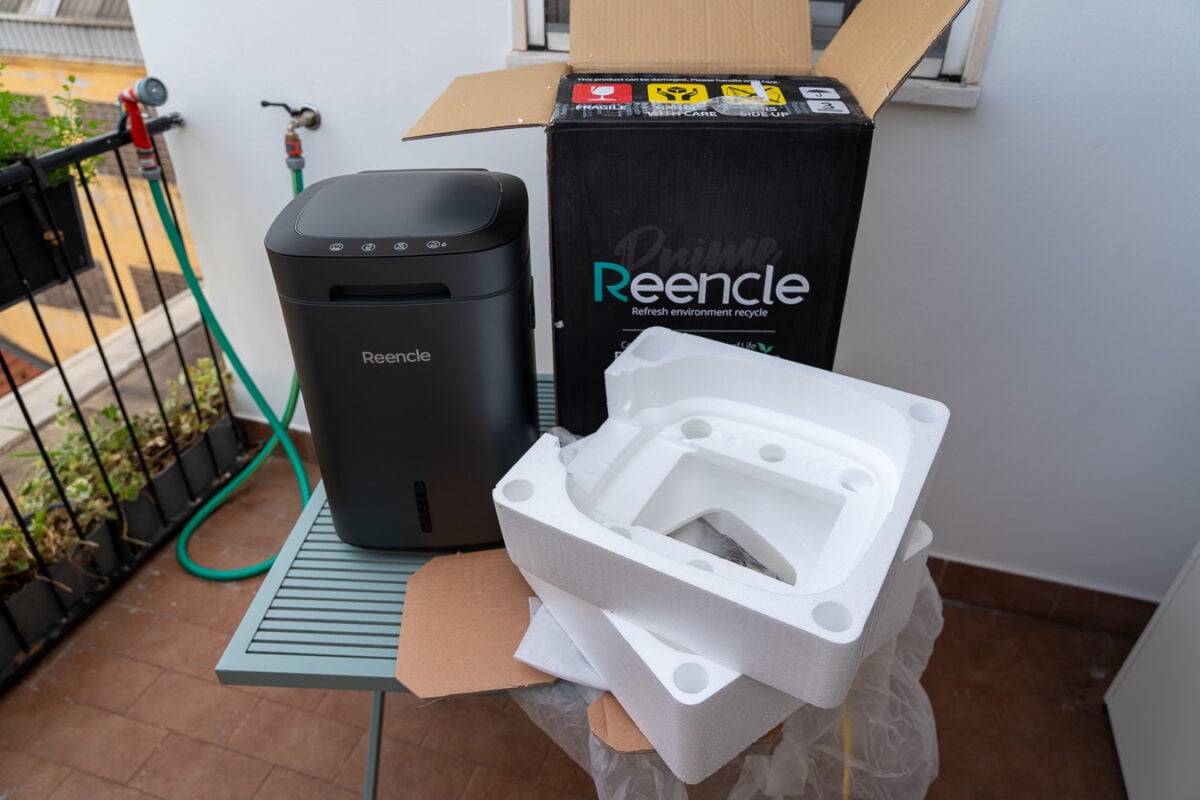
Second glitch: my quick-start guide was, for some reason, in Czech. We were in Italy for the summer when we started testing Reencle, so I guess they got their European wires crossed. (Don’t hate me; my husband’s from there and I swear we were working!)
No worries, though. We just looked up the Reencle set-up guide online.
Setting up Reencle & how we tested
The process to get the microbes all fat, happy, and ready to digest was pretty straightforward:
Add the microbe starter mix to the machine (it’s included) along with 1.8 liters of water and press the power button. (That’s about 7 cups, or 60 ounces, or 2 quarts.)
Tip: If you want to reduce the amount of dust that puffs up, add a little of the water before pouring in the microbe mix, and pour slowly.
Then wait 3–6 hours (according to Reencle’s website) after turning the machine on before adding food… Or wait 18–24 hours, according to the manual that came with our Reencle.
We checked in after 5 hours, but it was hard to tell if it was ready. (Was the smell “earthy” enough, as required? Or just woody, from the wood pulp in the starter mix?)
When in doubt, we decided to wait until the next day to add food.
Tip: Although we started setting ours up outside, Reencle is supposed to be inside. Where we had it was protected from rain and had zero chance of freezing overnight (summer in Italy), so we figured it was safe.
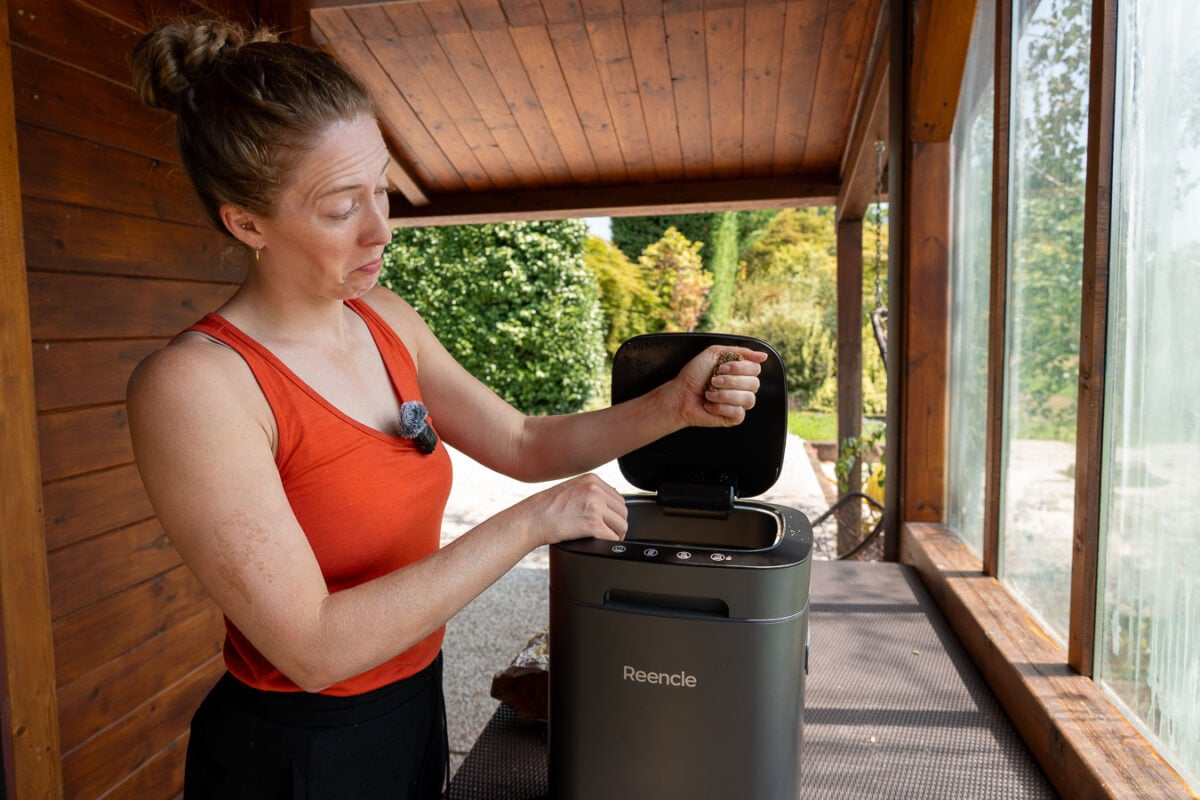
Baby Reencle’s bread diet (Day 1)
We came back after the machine had been running, gently waking up our sleeping Bacillus colony, for 21 hours.
We decided the smell seemed earthy enough (’cause sometimes you just have to decide these things). The starter material felt like slightly damp sawdust, which is what the instructions told us to expect.
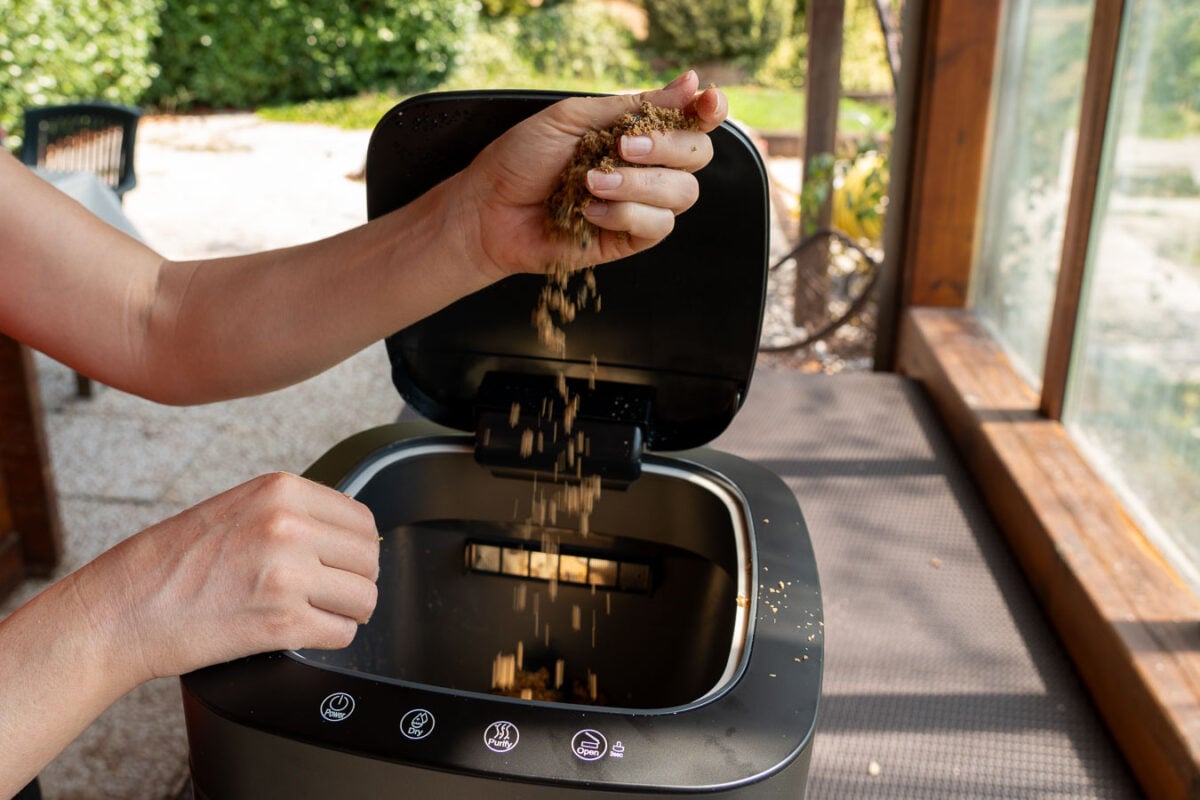
Looking good, so we kept going with the startup process: Baby’s first feeding.
On day one, you’re supposed to add only bread to the Reencle. Bread is an easy food for these Bacillus microbes to digest, and we want to keep them happy, like a Tamagotchi pet.
We had tasked our family with collecting unused bread for a week, so we were ready, and fed it about 250 grams on day one.
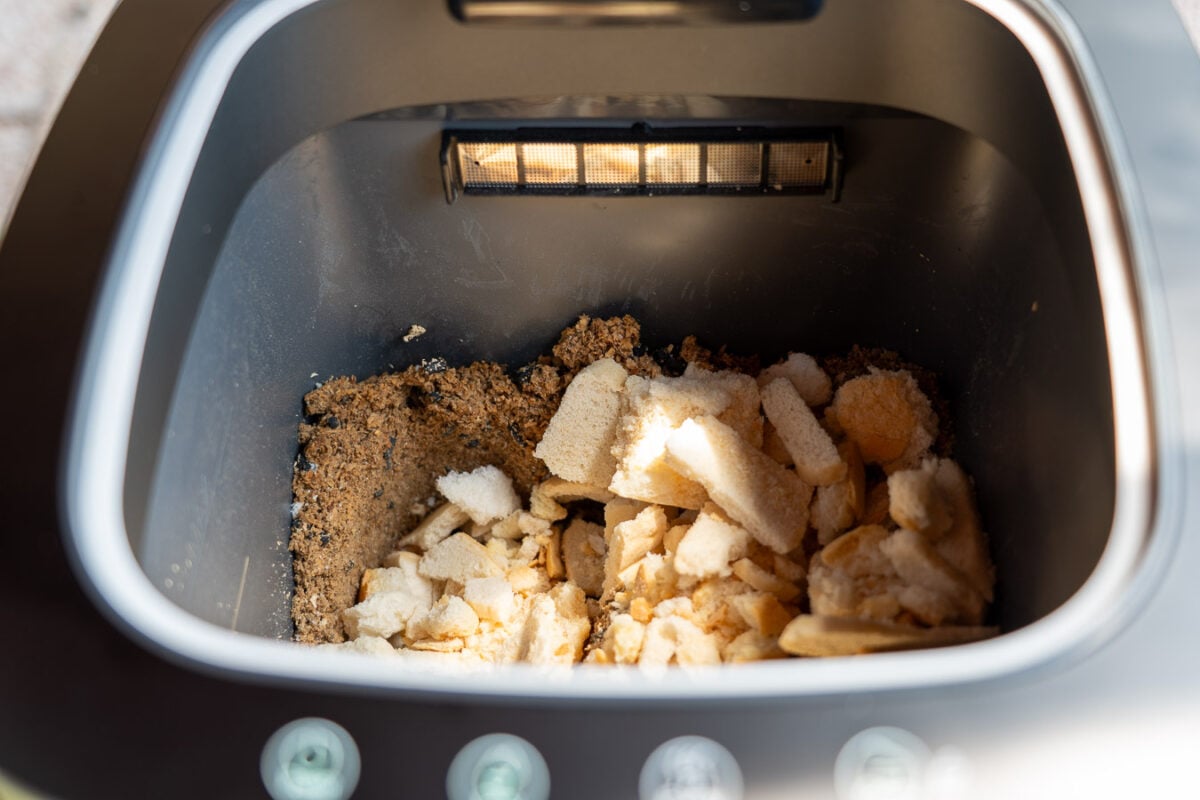
Your first test: On the first day of adding food to Reencle, the bread should be digested within 6–8 hours, which shows that the microbes are active and healthy.
We opened it up to inspect after about 6 hours, and sure enough, it almost looked like we’d never added anything. The bread was almost entirely gone. I had to dig around to find a couple of small chunks hiding in the starter material.
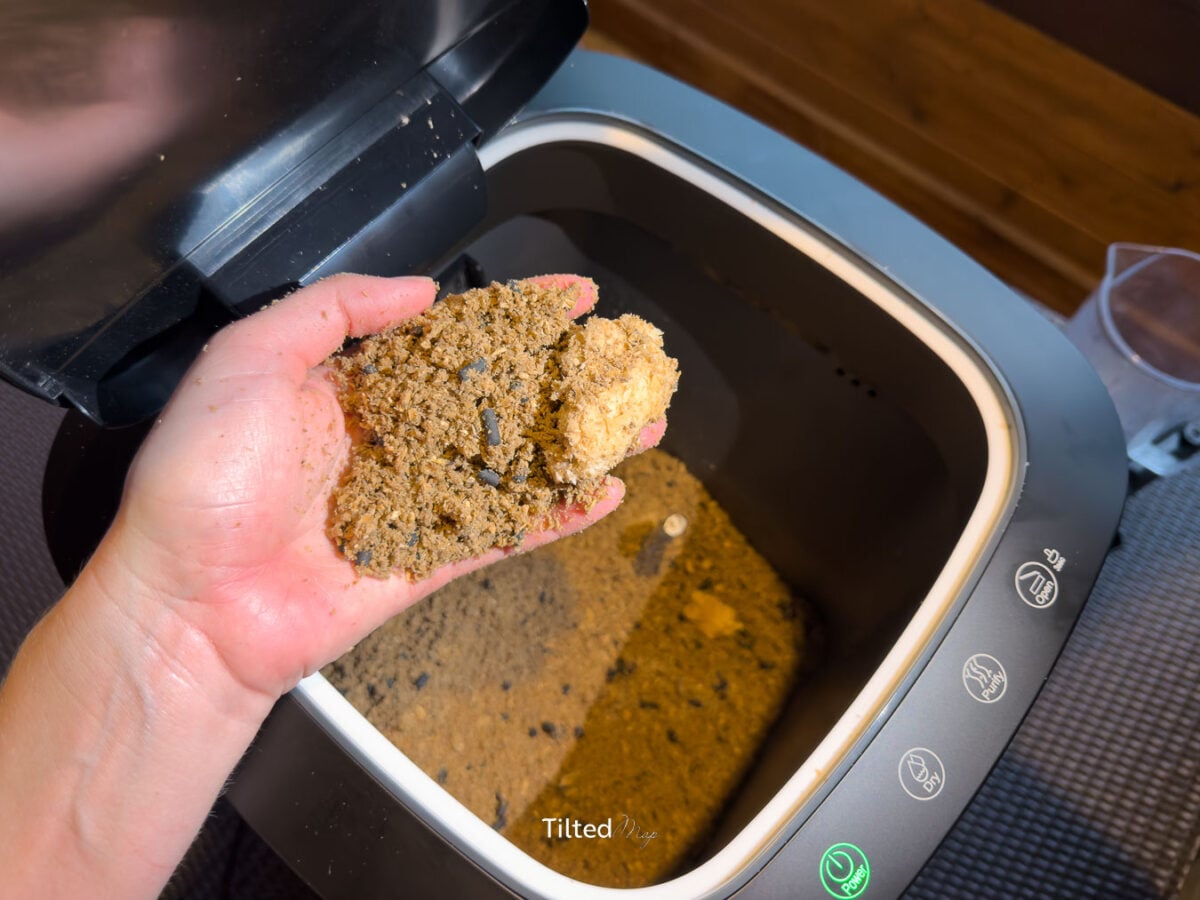
Week 1 feeding Reencle (lessons learned)
On days 2–5 of feeding, you still don’t feed your Reencle much (a max of 300 grams, or 11 ounces, of food scraps, as opposed to the usual 1 kg max, or 2.2 lb). But you can add other foods besides bread.
So on day 2, we added a bit of bread, along with a couple of watermelon rinds, fig peels and long-abandoned cucumber slices.
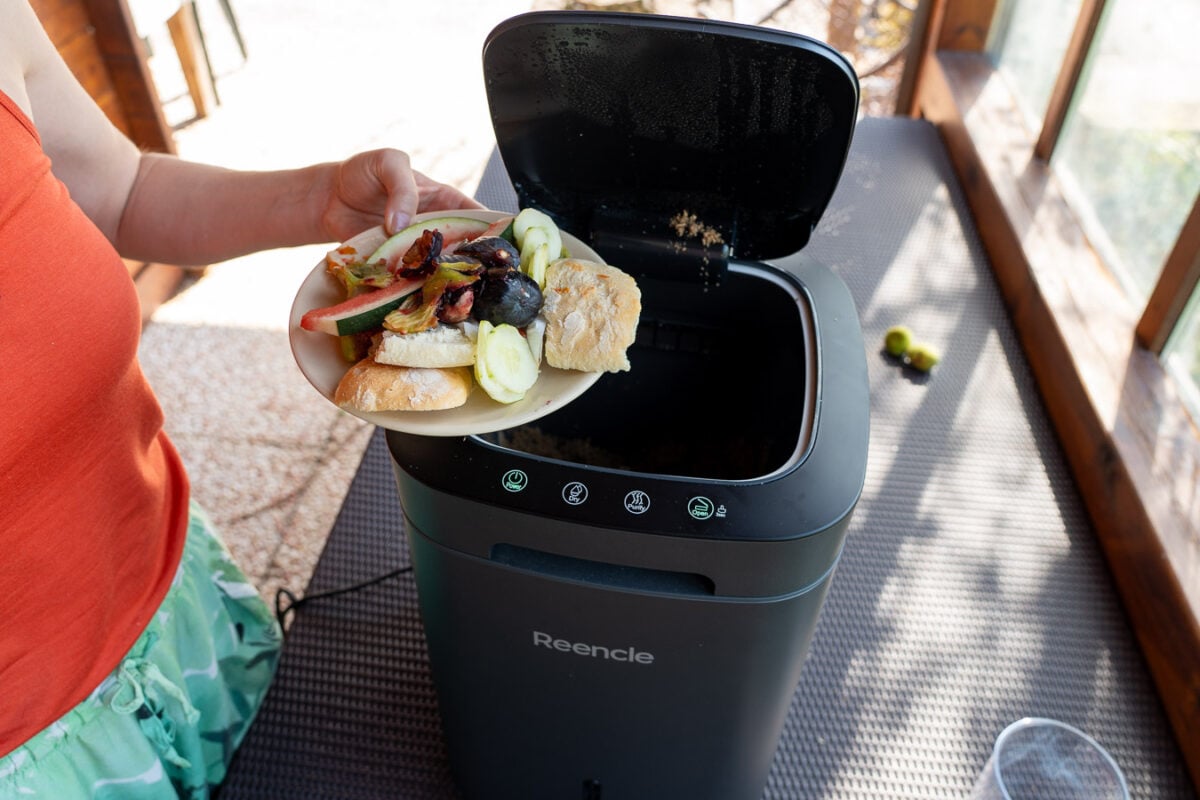
We kept going with a similar feeding plan for 3 more days, being careful not to add too much.
Day 3: leftover pasta and greens, bread, and one “compostable” coffee capsule. (Oops, we hadn’t yet read all the rules to learn Reencle says no pods. We kept an eye on it every few days. After several weeks, there was no trace of it. Since it took that long, I can see why loading the machine up with a pod or two a day would quickly become too much.)
At this point, we didn’t limit ourselves on food scraps, either. We also moved our Reencle inside, to our kitchen, where it belongs.
Day 4: pizza and chicken bones, which Reencle notes decompose slowly. They definitely went faster than the coffee capsule, but did take about a week to disappear.
Day 5: leftover lasagna, figs, bread
Reencle grows up (testing it in normal life)
After the first week, we basically stopped thinking about what we put into our Reencle. We used it as they recommend: After each meal, we added whatever was left: scraps, peels, coffee grounds, eggshells, cheese rinds, small bones, etc.
We haven’t really had any issues with it, and barely notice it anymore even when we’re in the same room.
Our microbe colony never got too wet, but it did get too dry twice. (Once when we were gone for three days, again after a week away.) The giveaway was a grinding sound that seemed to be coming from the stirring rod. Both times, adding a cup or two of water fixed it overnight.
Details: How much electricity does Reencle use?
Because the Reencle runs around the clock, it uses about four times more electricity than competitors like the Lomi. (Here’s my Lomi review.)
Reencle’s electricity use estimate for the Prime is 1.25 kWh a day. At the average electricity price for US homes (which is 18.2 cents per kWh in 2026), that’s about $6.80 a month, or $83 a year.
That’s more than the “about $2/month” that Reencle claims. Which would be true if your electricity cost 5 cents per kWh. (Of course, the actual cost depends on the rate you see on your electricity bill.)
In terms of annual usage, that’s about 456 kWh a year. And for context, that’s more power than a dishwasher (112 kWh), a microwave (107 kWh) or an electric stove + oven (290 kWh) use, but less than an average refrigerator (617 kWh), according to the EIA’s 2020 household energy survey. (We’re talking about a US-style fridge, which is bigger than what most of the world uses.)
So while it’s less than the cost of compost pick-up service, it’s likely more than Reencle says.
How to cure Reencle compost
Despite being more “real” than what the Lomi and Mill produce, Reencle’s compost isn’t finished the moment you scoop it out. (That’s because you keep adding fresh scraps every day, so some of what you harvest will still be in the process of breaking down.)
So you need to “cure” the compost before it touches roots or seeds (don’t worry, it’s easy). Once you do, it’s safe to use even for planting, as long as you mix it with soil.
(Reencle even had Penn State’s agricultural lab test a mix of three owners’ compost. After 3–4 weeks of curing, it scored 2.2 on a stability scale, where 1 was very stable, and 11 was not stable at all.)
Here’s how Reencle says to cure their compost, and what we actually did:
- Harvest when it gets to the MAX line. Scoop out compost until the level is back down to the MIN line, never lower. If you put in the maximum of about 1 kg of scraps a day, it should take 2–4 weeks before you need to harvest. (It took us about 2, and we removed half of the material.)
- Sift it. Put any lumps back in the Reencle. (We didn’t find any in the material we scooped out of the bottom.)
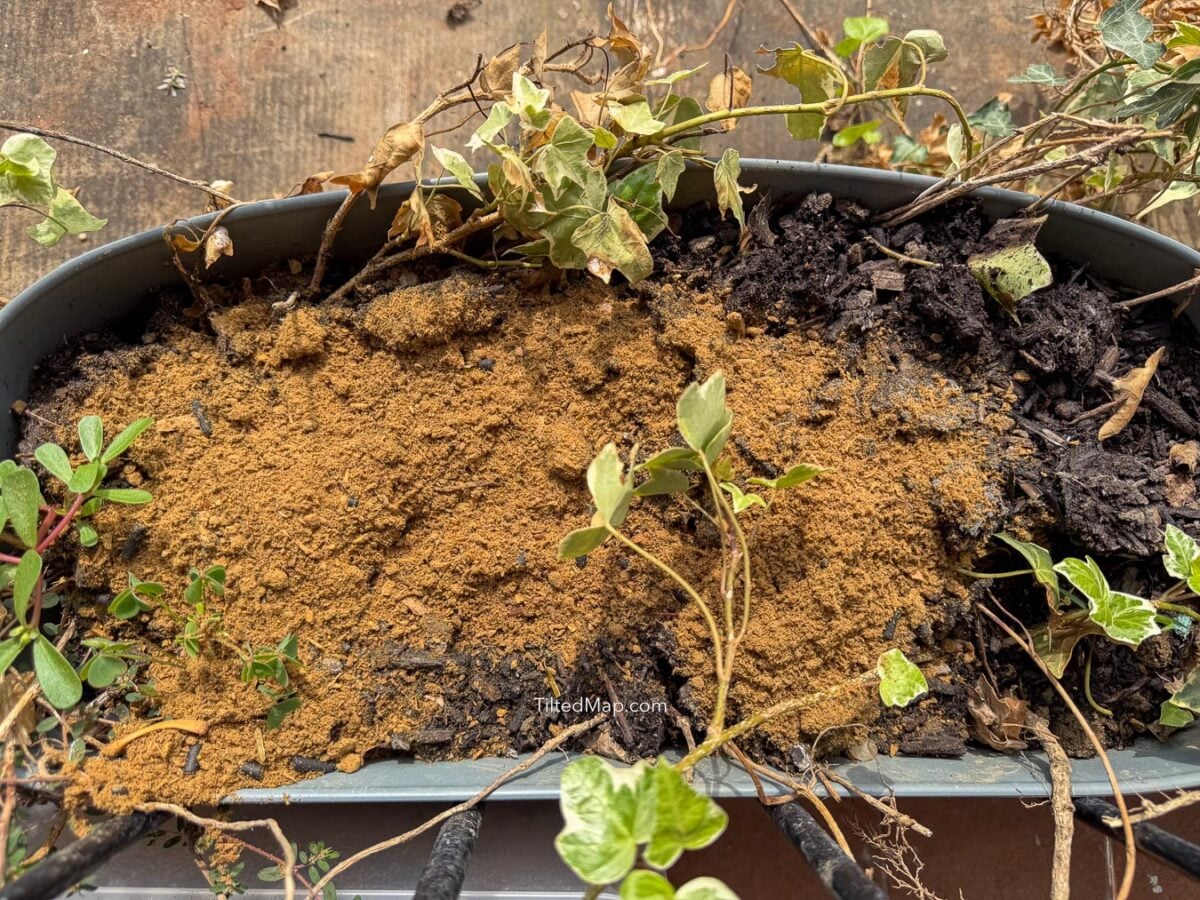
- For mulching, you can use it right away. Spread a thin layer around plants (not touching the stem), cover it with a little soil, then mulch.
- For planting or seeds, cure it first. That’s what’s in Reencle’s curing guide, and it’s how the Penn State samples were cured. Reencle’s planting guide adds two more steps: mix 1 part compost with 4 parts soil first, and stir it every 3 days or so.
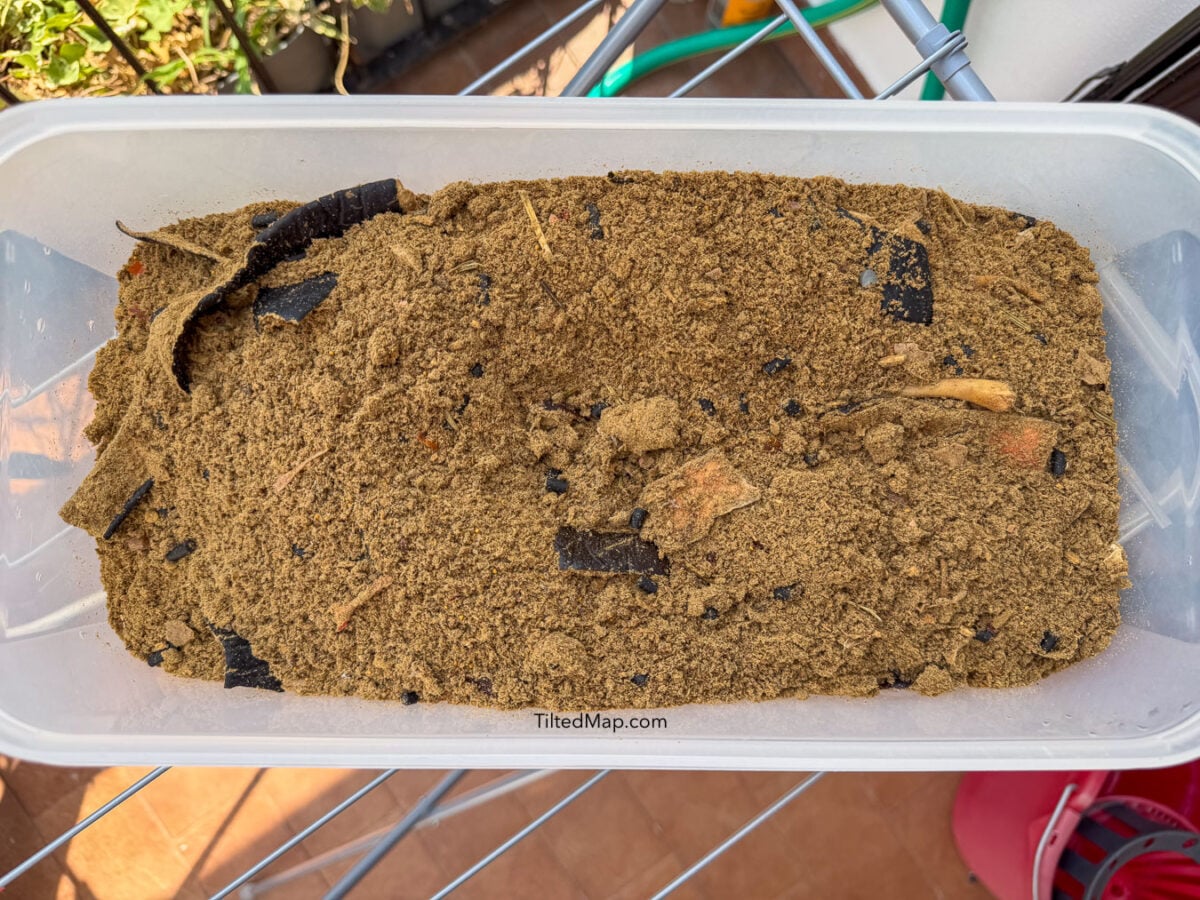
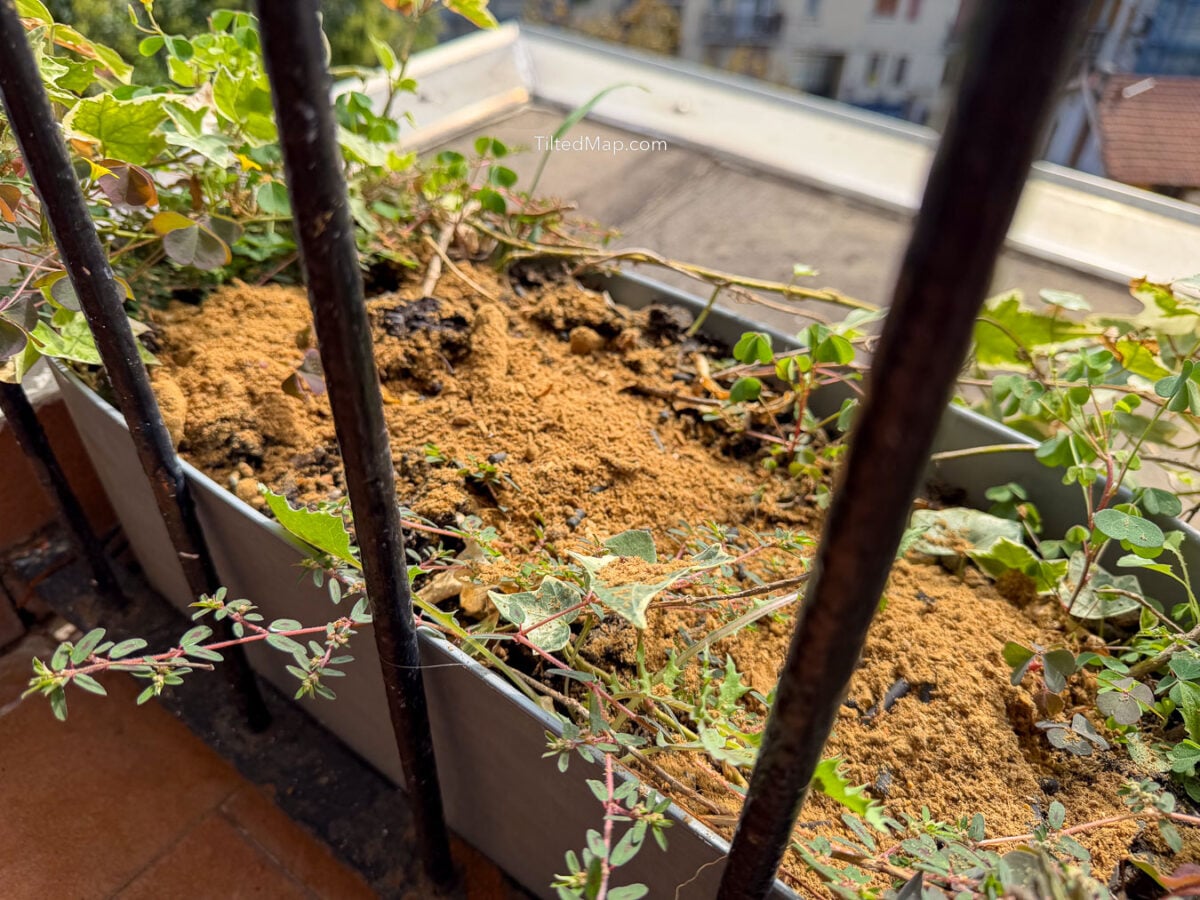
- (We put ours in an airtight container (oops), never stirred it (double oops) and waited about 2 weeks (triple oops) before spreading it on top of potted plants, touching the stems. Everything was still fine. No issue with the plants, even a couple weeks after spreading the compost.)
- It’s ready when it looks dark and crumbly and smells earthy, not sour.
Reencle FAQ
Yes! Microbes digest the food instead of just drying it like the food waste “dehydrators” (like Mill and Lomi) do.
And you can use it on your garden after “curing” it. A lab test rated its cured compost just short of fully “stable” (It scored 2.2 on a scale of 1–11.)
When the machine gets full, remove some of the material (not all), sift out any unfinished food chunks, store the compost in a breathable container for 3–4 weeks, and it’s ready to go. For mulch, there’s no curing needed; you can use it straight out of the machine. (Details in the curing section above.)
We’ve never smelled ours while it’s running, just a yogurt-y smell when we open the lid. Not unpleasant, in my opinion, but of course that’s highly subjective.
When there are smells, Reencle says they’re usually from the microbes getting too wet or too dry. (So the fix is easy: If it’s too wet, add more dry stuff, like bread or paper towels, or use the “dry” button. If it’s too dry, add a little water, then wait 6–8 hours before feeding it again.)
Yes! In general, if you can eat it, you can Reencle it.
Raw or cooked meat and fish are fine (Reencle says to cut them into small pieces). Eggs and dairy are fine in moderate amounts. Just make sure you’re putting in a mix of different stuff every time; try to avoid stuffing the machine with just one ingredient.
Every 9–12 months, to the tune of $35 for a new carbon filter for the Prime, $40 for the Gravity. There’s no alert or warning light. Instead, they say to change it when you notice a sour or stale smell coming out of the vent.
For trips under a month, leave it on and add a little extra food or water before you go. Pretty simple, we did it multiple times and it’s never been an issue – but be sure to check it when you get back home.
When we were gone for a week, we added 600 ml of water before leaving, and the compost was still dry and sandy when we got back. A little more water fixed it overnight.
For a month or longer, you have to taper off feeding over a week, unplug it when you leave, and restart it slowly when you’re back.
Yes! Right here: 👇
Reencle Home Composter
The cleanest, quietest, easiest way I've found to make REAL compost in your house.
Is the Reencle worth it? My final verdict
Yes, Reencle uses more electricity than the Lomi or Mill, and it does take some planning if you’re away for a month or more, but I still think it’s the best option for most people, and it’s the one I’d buy for myself. You can try one at home for 60 days and see if you agree.
Final thoughts if you’re not sure:
- Worth it if you want compost for a garden or potted plants, but don’t have the outdoor space or the time/ energy/ desire for outdoor composting.
- Worth it if you want food scraps out of your trash without planning batches.
- Maybe skip it if you’re not a gardener, and you’re often traveling for a month or more at a time. (Then I’d look at Lomi or Mill.)
- Try local options first if your city, or a local company, collects food scraps and you don’t need the compost yourself. (That’s the same advice as in my Lomi review. The most sustainable option is often no new gadgets.)
- Consider a Lomi instead if you travel constantly and mainly want less trash (and less smelly trash). You can unplug it between uses. (Mill also has an automatic vacation mode, so no unplugging.)
What do you think? Did this review help you? Feel free to leave a comment below with your thoughts, or any questions. (Remember, I’m a real person, and I read every comment! I’ll get back to you.)
Our video review of the Reencle Prime is coming soon! Subscribe to our YouTube channel to see it (plus lots of other sustainable product reviews and travel guides).
And get on my email list to keep in touch! (You’ll also get a useful freebie.)