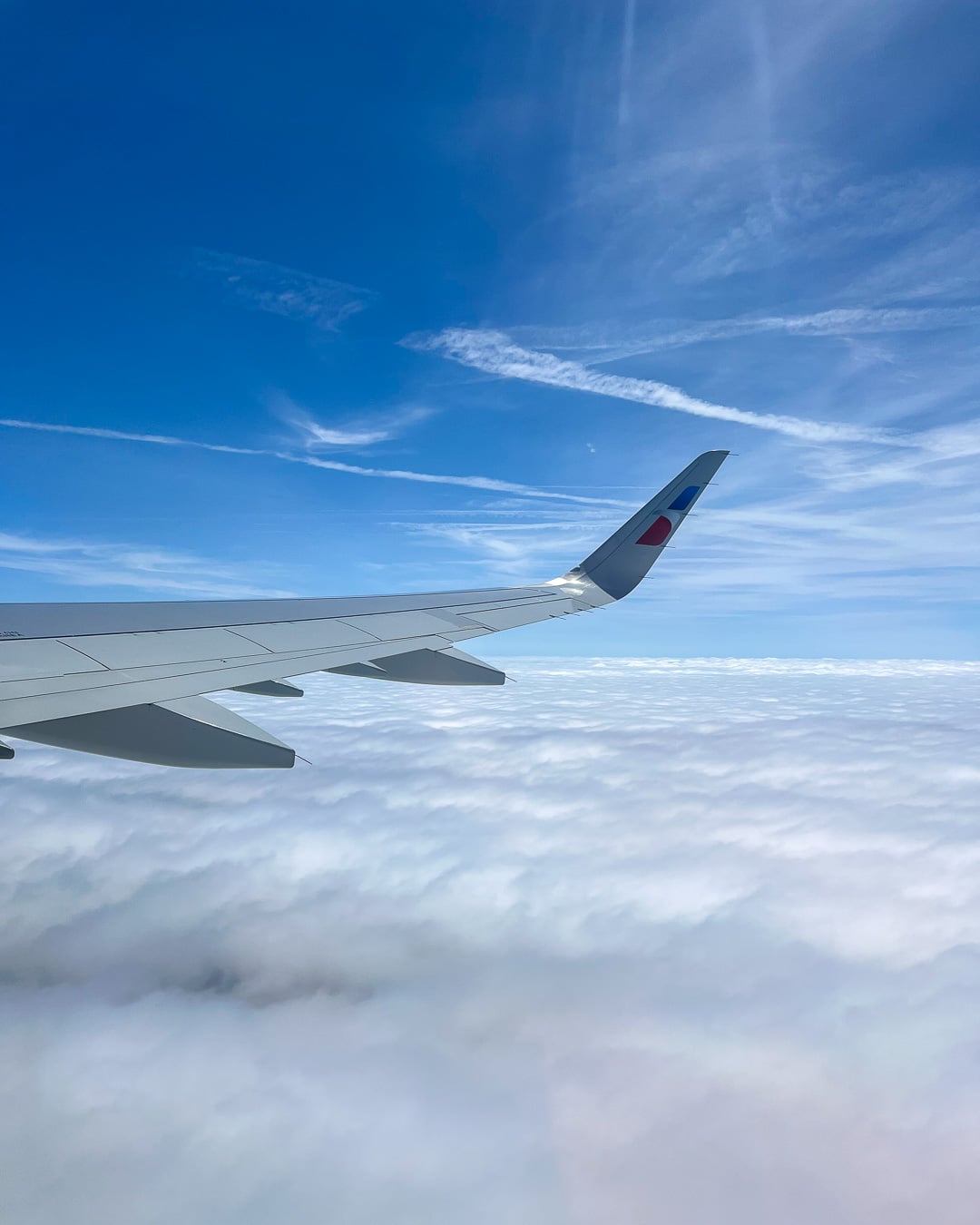
The Easy Change That Will Make Your Next Flight More Climate Friendly (+ the Science of Contrails)
This is Part 1 in a new series about sustainable aviation for travelers. This post answers three questions: 1. What are the main factors that influence a flight’s climate impact? 2. How can travelers find more sustainable flights? 3. And what are jet contrails?
If you’re like me, you wouldn’t give up traveling for anything in the world… and yet, every time you get on a plane, you can’t help but think at least a little bit about the environmental impact of all of us travelers jetting around the world.
Sound familiar?
You probably have a decent idea of what causes the climate impact of flying. Launching a giant metal tube full of people and their overweight luggage miles into the air takes a lot of energy, and we get that energy from burning fossil fuels.
That’s why aviation accounts for about 3% of global climate impact. And flights account for 80 to 90% of the climate impact of most trips we take.
True. But does it have to be that way?
It turns out there’s a lot of exciting innovation happening in sustainable aviation, and as travelers, we can help make sure it continues.
I’ve already shared lots of easy tips for more sustainable travel. But in this post, I’m going to break down one important factor you probably don’t know much about (jet contrails) and how it can make a massive difference in the climate impact of your next flight.
The short answer: Change where you book your flights.
BookBetter is a brand new flight search engine (launched in 2026) that lets you compare flights by price and by their true climate impact, including contrails and other factors. It’s the most useful and meaningful tool I’ve found for improving flight emissions.
(And I’ve been writing about the sustainability of flights for years. Many sites have come and gone; none have impressed me as much as BookBetter.)
Think of it like Kayak or Google Flights, except thoughtfully designed by a small team of geniuses in Europe to actually make travel more sustainable.
Tip: When you’re ready to book your next flight, check out my post with tips for using BookBetter – coming soon!
And the long answer is so much more fun! So if you’re interested in genuinely shrinking the climate impact of your travel, read on.
First though, let me introduce myself.
Who’s writing this?
Hi, my name is Ketti Wilhelm. I’m a real person, not an AI bot! I have a master’s degree in Sustainable Business and Energy, and I founded Tilted Map in 2019. Why? Because I wanted to keep writing about travel (I used to write for magazines) but focus on realisticsustainable travel advice that all travelers could use. (And I still research and write every article myself; no AI here.)
I also write a lot about sustainable, plastic-free products that are actually worth trying, so check out that section when you’re done here!
Lately, through my research on sustainable aviation, I’ve been through a powerful refresher on what actually influences the climate impact of a flight. And I’ve learned we have a lot more power to choose more sustainable flights than most people realize.
How, though?
There are some very easy choices we can all make to genuinely improve the climate impact of our flights.
…But only if we know what actually moves the needle. Hint: I’m not here to tell you to just take a train instead of flying (good idea; not always possible) or to buy carbon offsets for your flights (I’ve already written a lot about that bucket of worms).
So after spending many hours talking with the founders of BookBetter, I wrote this guide to translate the whole “sustainable flying” conversation into plain English. (Because it’s powerful information that I wish every traveler knew, but most of it is a little dry to read.)

Okay, but who’s paying you?
This article is not sponsored by anyone. I took time out of my work days to interview experts and write this because it’s important.
BookBetter is an affiliate partner of TiltedMap, which means that if you use the discount code below when booking your flight, you’ll save 10 euros, and I’ll earn a small commission.
(That’s part of how this blog makes money, which I’ve always been purposefully transparent about. I think it’s important for you to know how the internet actually works, and I appreciate your support and trust that you’ll be more likely to give it if you know how.)

And like all travel bloggers and travel sites, I can also earn commission (without doing all this research) by just sending you to Kayak to book your flights. So there’s that. And anyway, if I just wanted to get rich on the internet, I’d probably be selling pictures of my feet.
Let’s get into it:
What makes one flight better than another?
For the ways to improve the climate impact of flights to make sense, we need to understand where the impact is actually coming from. What makes getting a metal tube into the air such a big deal?
4 main factors determine the climate impact of any flight:
- How far the flight goes – the longer the flight, and the more layovers, the more fuel. (The majority of fuel is burned in take-off and landing, which is why flying direct is so powerful.)
- What kind of engine the plane has – new and efficient or old and clunky? (Airplane engine efficiency has improved more than 40% in the last 50 years, so the difference matters!)
Those two are pretty obvious, right? And they’re pretty much determined by where you’re flying.
(Sure, you can try to book a flight on the most efficient aircraft, like the Boeing 787-9 (for long-haul flights) and the Airbus A321neo (for short and medium-haul). But airlines can change the equipment after you book.)
That’s why I think the next two factors are the most interesting: They make a huge difference for flights on the same airplane, going to the same place.
- What kind of fuel the plane burns – this is what causes greenhouse gas emissions. Technically, it’s the “CO2e impact” of a flight. (The “e” stands for “equivalent.” It means they take all the greenhouse gasses and convert them to CO2 for easier comparisons.)
- When and where it burns the fuel – this is mostly about “contrails.” Technically, it’s the “non-CO2 impact” of a flight.
Tip: BookBetter takes all four of these factors into account in their flight search results, so you don’t have to figure it out yourself.
But for the sake of nerding out, let’s dive into the last two. There’s really exciting, POSITIVE news on both of those fronts!
What do you mean “what kind of fuel”?
There are basically two options for the type of fuel your flight can use:Old-fashioned jet fuel vs modern Sustainable Aviation Fuel (or SAF). Flying with SAF can reduce the greenhouse gas emissions from a flight by 80% or more!
We’ll get into that soon, but first, let’s talk about the other part of the equation – the “non-CO2” impact.
Who cares “when and where we burn the fuel”?
When and where jet fuel is burned determines how many “contrails” form – you know, those pretty white stripes in the air?
Don’t worry, I’m not a conspiracy theorist; you haven’t stumbled into a crazy corner of the internet. Contrails are not government spy dust. But what they are is much scarier: Contrails can contribute as much as HALF of the total climate impact of a flight!
They’re extremely powerful. Luckily, there are many ways to minimize them.

What are contrails?
Contrail is short for “condensation trail.” It’s the exhaust that comes out of a jet engine’s tail pipe and freezes at high altitude. (It’s cold up there at 35,000 feet! And exhaust is a lot of water vapor. It freezes.)
Most contrails don’t last long (only a few minutes) which means they don’t have a huge climate impact.
But when planes fly through areas of particularly cold and humid air, those contrails can stick around for hours. And that creates frozen clouds that basically act like blankets, keeping the planet nice and… hot. Too hot.
Instead of heat just escaping into space, contrails cause heat to stay here and warm our climate even more.
Wait, now is this the contrail conspiracy?
Again, I hate to have to hammer this point, but it’s important to clarify: NO, contrails are not “chemtrails” made to poison us, or spy on us, or whatever the spin doctors on the fringe want you to be scared of this week. No conspiracy theories here, just actual science. Which is scary enough, but also empowering when you understand it.
How to choose more sustainable flights with fewer contrails:
Easy: fly during the day instead of at night! That’s the simplest and most powerful contrail factor we can easily control as travelers, but of course, there is a bit more to it.
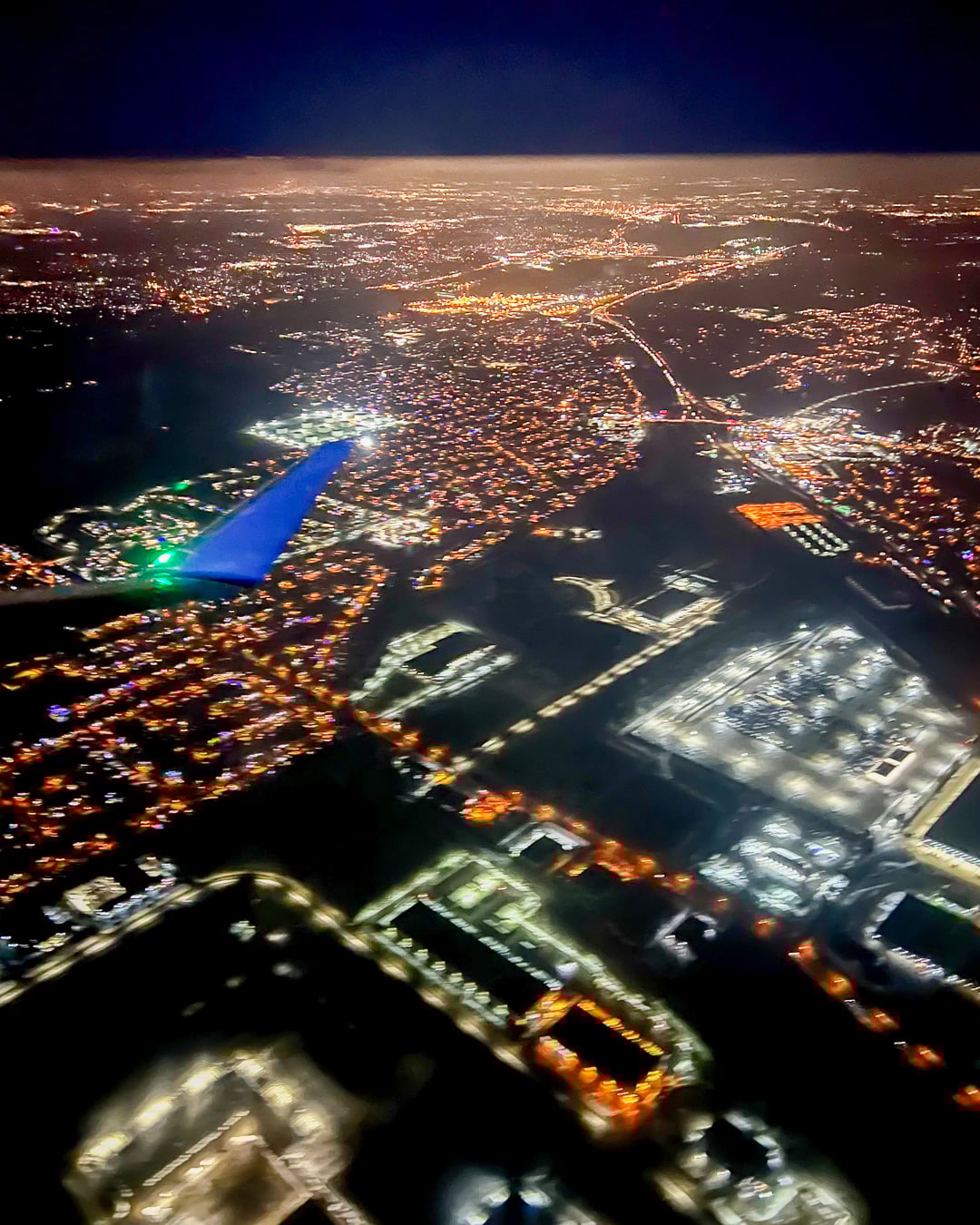
For example, unfortunately, autumn and winter flights are more likely to create contrails that cause warming. I say “unfortunately” because I love to recommend shoulder season and off-season travel. (But fall is kind of the best season everywhere, so maybe it’s a time when we should all start staying home?)
This excellent article visualizes when, where and why most contrails are formed. (Graphs! Colors! Fun!)
It’s super useful for understanding what kind of government policy we should be advocating for. But in case you’re not holding your breath waiting for that to happen, it also gives lots of useful advice on the best time to book flights depending on the route. (Since simply choosing a daytime flight isn’t always possible.)
So that’s half of the equation already, the “non-CO2 impact” of flights.
Now this might be bringing up a good question for you:
The Billion Dollar Question
This is usually about the third question I hear when I tell a stranger that I write about sustainable travel, and it’s a good one:
“Why should it all be on us, as individuals, to fix these things?”
– everyone
The short answer:
Of course, it shouldn’t be. But it is, because capitalism.
And no, it’s not our fault (we didn’t choose to be here, in a fossil-fuel-powered world). But it is our responsibility to change it (if we choose to accept the challenge. And the alternative is pretty sad, so I say accept).
While Spiderman’s uncle said “with great power comes great responsibility,” don’t forget that the reverse is also true: With great responsibility comes great power.
The long answer:
The whole aviation industry needs signals today.
That’s why it’s on us, as travelers and consumers, to support contrail reduction, SAF and all the other more sustainable changes we’d like to see in the world: Because our support is a powerful signal.
And that’s one of the ways capitalism can actually be useful.

That’s how Louis explained it on a recent webinar. To paraphrase what he said:
“If no one shows the airlines, through purchases, that low-emission choices matter, they won’t develop them. We hear this all the time: ‘It’s difficult to develop these technologies if the market doesn’t show any demand for less-polluting travel.’ So let’s not wait until we have the perfect solution. Let’s do stuff today.”
Louis, BookBetter co-founder
Let’s do stuff today is pretty much the only option we have if we want anything to ever change, so I agree. Let’s do stuff.
Start by booking your next flight on BookBetter, and using my code below. That supports them in creating an easy way to find more sustainable flights and to buy certificated Sustainable Aviation Fuel. (And as their ambassador, it supports me in being able to tell you about it.)
Next:
Check out my next post about BookBetter’s other super power, Sustainable Aviation Fuel, and why I’m so excited about it!